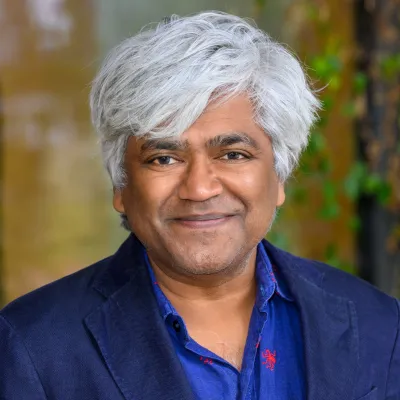
Unni Karunakara
How can global health policy move beyond mere rhetoric about solidarity? Is Germany willing to share its power and resources with those who need them most—or does the solidarity that underpins the German health care system at home end at the border?
More about Unni Karunakara
Unni Karunakara grew up in Kerala, India, in a society deeply committed to health care equity yet still shaped by caste, class, and religion. As a medical student in the 1980s, he listened to BBC World Service reports about "French doctors" working in famine-stricken Ethiopia and was struck by the idea that medicine could be something other than clinical routine. That idea took another decade to become a life.
After qualifying as a doctor and beginning radiology training, he found his way to public health after realizing: Medicine was largely about illness while health was more about wellness – and determined by politics, economics, and power. A turning point was an early internship in South Africa in 1994, just as the first post-apartheid government took power, where he met physicians for whom justice was inseparable from medical practice. A chance encounter at Brussels Airport led him to Médecins Sans Frontières (MSF). His first assignment: setting up a tuberculosis program in the Ogaden Desert of Ethiopia.
What he found there – as well as in Azerbaijan, Congo, Haiti, Somalia, and dozens of other crisis contexts over three decades – convinced him that structural change, with a shift in power, is key to fairer health systems across the world. As MSF's International President (2010–2013), he led one of the world's most respected medical humanitarian organisations through some of its defining moments. As a senior fellow and teacher at Yale University and the United Nations University, he has continued to pursue the question that has run through his entire career: how do national and international political and economic arrangements determine people’s health – and how could they be grounded in genuine humanity and solidarity rather than the interests of the few?
During his Richard von Weizsäcker Fellowship, Unni Karunakara is examining Germany's emerging role in global health governance: its commitments, its contradictions, and its capacity for genuine solidarity.
Resumé
1964 Born in Ahmadi, Kuwait
1982–1990 MB BS, Kasturba Medical College, Mangalore University
1993–1995 MPH in International Health, Yale University School of Medicine.
1995 Joined MSF; set up tuberculosis control programme in Jijiga, Ethiopia (first assignment)
Late 1990s Medical Coordinator/Advisor, MSF: Azerbaijan, Brazil, Democratic Republic of Congo
2000–2001 Visiting Study Fellow, Refugee Studies Centre, University of Oxford
2001 Co-founded VIVO — organisation addressing traumatic stress and its consequences
2002–2005 Health Advisor, MSF: Angola, Brazil, Colombia, Republic of Congo, El Salvador, Haiti, Iraq, Mexico, Uganda, Zambia, Zimbabwe
2004 DrPH in Population Dynamics, Johns Hopkins University School of Public Health.
2005–2007 Medical Director, MSF Campaign for Access to Essential Medicines, Geneva
2008–2010 Deputy Director of Health, Millennium Villages Project / Earth Institute, Columbia University
2010–2013 International President, Médecins Sans Frontières, Geneva
2013– Assistant Clinical Professor, Yale School of Public Health
2014–2017 Senior Fellow, Jackson Institute for Global Affairs, Yale University
2020– Senior Fellow, Global Health Justice Partnership, Yale Law School / Yale School of Public Health
2024 Director a.i., UN University International Institute for Global Health, Kuala Lumpur
2026 Richard von Weizsäcker Fellow, Robert Bosch Academy, Berlin
Unni Karunakara's Richard von Weizsäcker Fellowship
Germany's global health engagement: Solidarity or just rhetoric?
As a Richard von Weizsäcker Fellow, Unni Karunakara plans to investigate how Germany understands and acts on the principles of solidarity, justice and equity in global health. With the United States withdrawing from multilateral health engagement, including from the World Health Organization, Germany has articulated a clear ambition to step into the vacuum. Yet the basis of that leadership remains an open question, he says.
Putting justice and equity at the heart of health
Berlin’s moves to center global health debates through the annual World Health Summit, its championing of a Pandemic Treaty and its push for sustainable WHO funding signal a claim to principled leadership in global health issues.
Yet during the COVID-19 pandemic, Germany also led the bloc opposing a near-universal call for a temporary suspension of intellectual property rights on COVID-19 medicines and vaccines (the TRIPS waiver), which would have let poorer nations manufacture their own doses, Karunakara points out.
These are not minor discrepancies. They go to the heart of what "solidarity" means in practice, he says: The TRIPS debate exposed protectionist instincts within liberal free-market ideology – and raised a sharper question: why do the solidarity principles anchoring Germany's own statutory health system appear to stop at the border, giving way abroad to market-based financing, public-private partnerships, and voluntary contributions?
Shifting power in global health
Karunakara also plans to pursue debates on shifting power in global health – moving decision-making, resources and knowledge away from wealthy institutions toward those most affected. How Germany understands and operationalizes this shift matters enormously for the people whose health depends on it, he argues.
His central questions:
- Does Germany's growing role reflect a genuine rethinking of power, or reproduce old patterns under new language?
- How can global health commitments be honored as development aid declines, decision-making migrates from intergovernmental forums to multi-stakeholder platforms, and the German government frames global health as an instrument of security and economic interest?
To explore these questions, he plans to conduct interviews with parliamentarians, policymakers, researchers, and civil society activists across the political spectrum.