Festival of Ideas
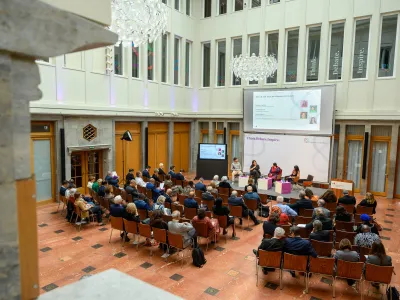
Academy Talks
Round Tables
Panel Discussions
How can we build partnerships across borders and divides? This question guides this year’s Festival of Ideas at the Robert Bosch Academy.
The festival opens the Academy’s Richard von Weizsäcker Forum, welcoming the public to the Robert Bosch Stiftung at Französische Straße 32 in Berlin. Academy Talks, panel discussions, and round tables offer opportunities to engage directly with international experts.
Under the theme Forging Partnerships and Building Alliances, join around 100 international leaders from politics, academia, culture, business, and civil society to challenge assumptions and explore cooperation across divides. We look forward to welcoming you.
When winning isn’t enough: How can democratic coalitions hold together?
Authoritarian populism doesn't just divide societies along one clean line – it fractures them in multiple directions at once, pitting dominant against non-dominant groups while deepening polarization within minority and marginalized communities themselves. These fractures look different in Budapest, Warsaw, and Detroit, but the underlying pattern is recognizable across all.
Hungary, Poland, and the United States offer three vantage points on the same unfinished story. Hungary has just achieved what many thought impossible: a broad coalition toppling one of Europe's most entrenched authoritarian populists in a landslide. Poland defeated rightwing populist Law & Justice Party (PiS) in 2023, but two years on is still struggling to dismantle the institutional architecture the party built. And the United States, which successfully voted out Donald Trump in 2020, watched his movement return stronger four years later, a reminder that electoral victory alone does not undo the conditions that produce authoritarian populism in the first place.
Taken together, these cases suggest that bridging and movement-building are not strategies to deploy at election time and set aside afterward. They are the ongoing, unfinished practice of democracy itself – work that runs across power asymmetries between dominant and non-dominant groups, through deep disagreements within marginalized communities, and between movements that share goals but operate from very different identity positions. And if the far right has understood its project as transatlantic – building shared infrastructure from Budapest to Washington – the movements opposing it need that exchange too.
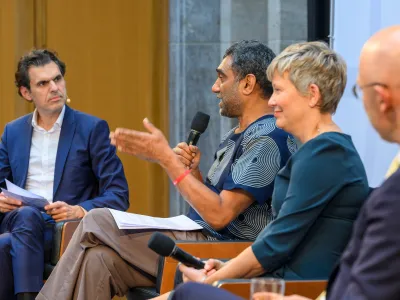
The session will open with a short keynote from john a. powell, Richard von Weizsäcker Fellow and Director of the Othering & Belonging Institute at UC Berkeley, on what bridging demands when identity is complex, power is uneven, and coalitions must hold weight in multiple directions at once. This is followed by a panel discussion bringing john together with others from Hungary and Poland to explore what these dynamics look like on the ground – and what the three cases can teach each other about the work that comes after the ballot box.
This discussion will be moderated by Nataliya Novakova.
Speakers
-
Image
 john a. powell
john a. powell is a law professor and Director of the Othering & Belonging Institute at the University of California, Berkeley. Born in Detroit, his experience of poverty and segregation shaped a career advocating human rights, equality, and diversity. He argues that bridging narratives are essential to countering the authoritarian challenge to democracy.
-
Image
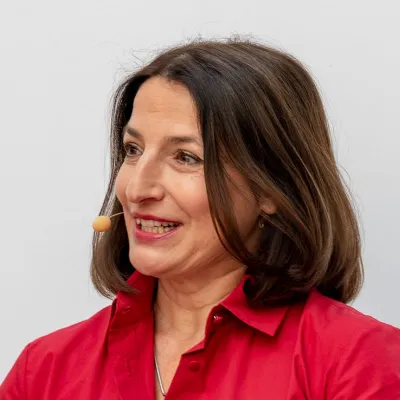 Zsuzsanna Szelényi
Zsuzsanna Szelényi is a Hungarian politician and expert in foreign policy. She was a founding member of the centrist party “Together” in 2012 and a member of the Hungarian Parliament from 2014 to 2018. She established the Visegrad4Europe project to organize pro-European advocacy in Central Europe.
-
Image
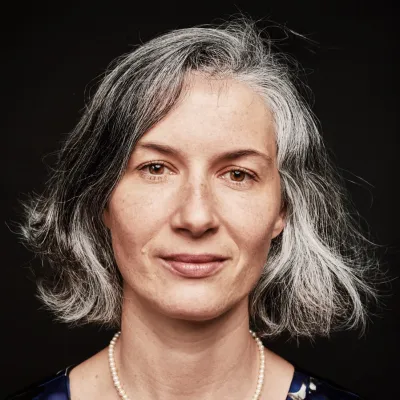 Karolina Wigura
Professor Karolina Wigura is an academic and author. She is Associate Researcher at the Oxford School of Global and Area Studies.
-
Nataliya Novakova
Nataliya Novakova serves as the Civil Society Forum's (CSF) Executive Director. Nataliya’s journey in human rights and justice began as an activist during Ukraine’s 2014 Revolution of Dignity. Most recently, she led the Europe division of the International Detention Coalition (IDC), working to uphold the rights of people on the move across the region. Her work has focused on human rights, migration and democracy.