Festival of Ideas
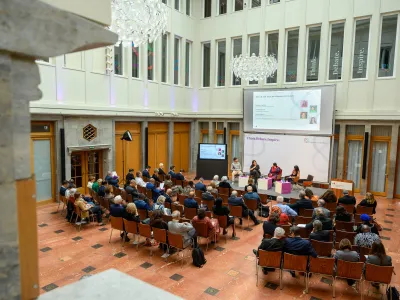
Academy Talks
Round Tables
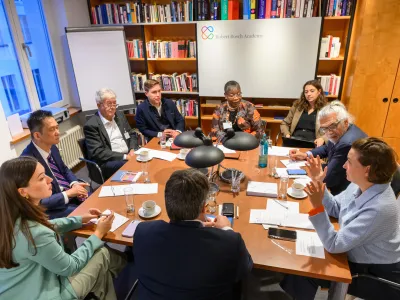
Panel Discussions
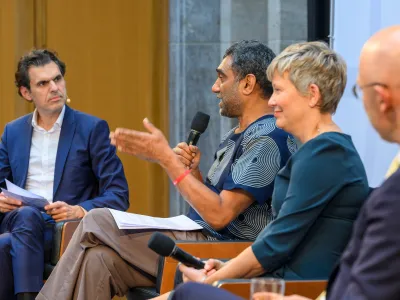
How can we build partnerships across borders and divides? This question guides this year’s Festival of Ideas at the Robert Bosch Academy.
The festival opens the Academy’s Richard von Weizsäcker Forum, welcoming the public to the Robert Bosch Stiftung at Französische Straße 32 in Berlin. Academy Talks, panel discussions, and round tables offer opportunities to engage directly with international experts.
Under the theme Forging Partnerships and Building Alliances, join around 100 international leaders from politics, academia, culture, business, and civil society to challenge assumptions and explore cooperation across divides. We look forward to welcoming you.
City leadership on the global stage: What would it take for cities to obtain a relevant voice?
Cities are no longer background actors in global affairs; they are becoming structurally necessary nodes in a changing multilateral order. Wars displace people into cities; climate change is reshaping where people can live; but the institutions built to govern these problems were largely designed for a world of states, not a world of metropolitan regions. Mayors and local leaders are being asked to absorb the consequences of decisions made far from city hall in war rooms, in climate negotiations, in national capitals while having comparatively little say in how those decisions are made or financed.
At the same time, the international system is visibly, if unevenly, opening a door. The 2024 Pact for the Future explicitly recognized local and regional governments as partners in delivering the New Urban Agenda, climate action, and digital cooperation. Concretely, the Pact's Global Digital Compact sets city-relevant commitments on data and AI governance for the first time. And the Global Alliance of Mayors for Digital Cooperation, launched by UN-Habitat and the UN Secretary-General's Tech Envoy in 2023, helps mayors put those commitments into practice locally.
Researchers who study cities as networked, tech-enabled diplomatic actors have been making a parallel case for several years: that this kind of horizontal, city-to-city cooperation is becoming a genuine complement to, not just an implementer of, national and multilateral policy. City networks are now pushing to convert that rhetorical recognition into standing, financing, and protection.
This panel makes the case that city leadership has already proven its value on the world stage and asks what it will take, structurally and politically, to match that value with real authority, resources, and safety.
Background reading: https://www.mdpi.com/2076-0760/15/5/304
Speakers
-
Image
 Colleen Thouez
Colleen Thouez is Vice President of the National Association of Higher Education Systems (NASH), where she leads workforce development across America's public universities. She spent seventeen years at the United Nations and works to give cities a voice in global migration policy. She also co-founded a charity bringing Ukrainian children respite from war.
-
Image
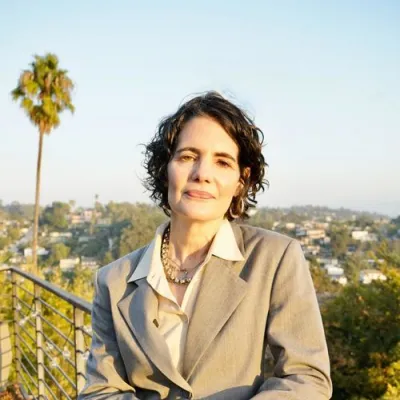 Ambassador (ret.) Nina Hachigian
Ambassador (ret.) Nina Hachigian is the founder and CEO of the Alliance for Local Leaders International, a nonpartisan nonprofit dedicated to supporting and connecting mayors and governors globally to solve shared challenges. From 2022 to 2025, she was the first U.S. Special Representative for City and State Diplomacy at the U.S. Department of State.
-
Image
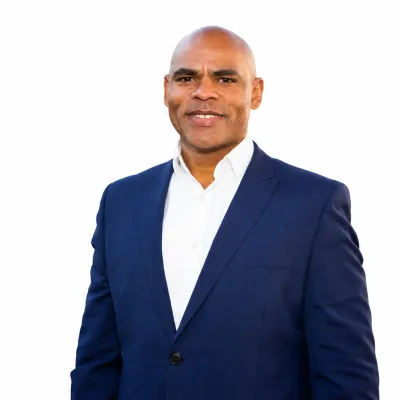 Marvin Rees
Marvin Rees served as Mayor of Bristol from 2016 to 2024, becoming the first directly elected mayor of African heritage in any major European city. His tenure was defined by bold action on housing, climate and social inclusion.