
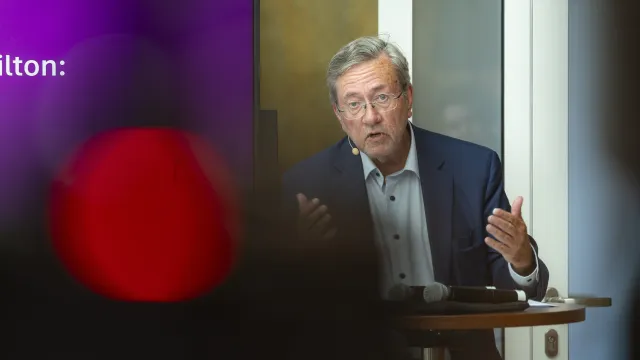
Daniel S. Hamilton gave the inaugural Academy Lecture at the Robert Bosch Academy in May 2026. Please note: The text below may differ slightly from the delivered lecture.
It is a pleasure to return to the Robert Bosch Academy among friends and colleagues. I am deeply grateful for the Foundation’s support over the years and welcome this opportunity to again express my appreciation.
After I left the State Department, the Foundation supported me in creating the Richard von Weizsäcker Professorship at my university. I had the privilege of knowing Richard von Weizsäcker; holding a professorship bearing his name has not just been an honor, it has been an obligation – to speak plain and often difficult truths, and to understand that leadership is best expressed through stewardship.
Maybe this connection is why Dieter Berg, who led the Foundation then, asked me to help launch a new project. I asked what it was. He said, “We’re calling it the Richard von Weizsäcker Fellowship. It will be in Berlin. We want you to help us start it.” I replied, “Sounds interesting. How much time would you need from me?”
“A year,” he said. “When would I need to start?” I asked. “In two months,” he said. I wanted to help, but I could not just drop everything in Washington and come to Berlin for a year. So I offered to come for a few months initially, and then perhaps to return later. And that’s what happened.
Some months later, I returned to meine zweite Heimat, Berlin, as this wonderful building was still under construction. The sweet music of jackhammers filled the air as I tried to fulfill the Foundation’s expectations and meet the obligations imposed by my ongoing association with the name Richard von Weizsäcker. I was so pleased to be present at the creation of what has become the Robert Bosch Academy and its community of Fellows.
Then, a particularly momentous event happened: A new hotel being built next door, aptly named the Titanic, slipped its moorings and tilted into the new Bosch building. All sorts of consternation ensued, but my brief time was up, and it was time to go home.
Thankfully, this building doesn’t seem to be tilting, and the Robert Bosch Foundation hasn’t lost its footing. It is important that you stand steady, because the transatlantic relationship has also now slipped its moorings. The original Titanic comes to mind. When it was built in 1909, its owners proudly proclaimed it to be “practically” unsinkable.
That is a good description of how we have thought about European-American relations for the past 80 years. Practically unsinkable.
To our horror, we’ve discovered a crack in the hull. If we look closely, we can see that this tear is not between the United States and Europe; it is between transatlantic liberals and transatlantic illiberals, between mainstream actors on both sides of the Atlantic and an emboldened transatlantic alliance of American and European far-right insurgents who are challenging the norms that guide our societies and that have framed the transatlantic partnership for eight decades.
To clarify, I use the term “liberals” to cover the range of political actors – left, right, or center – who consider themselves part of Western liberal tradition, defined by commitment to pluralism, protection of individual liberties, democracy, separation of powers, and the rule of law. “Illiberals,” in turn, are largely white ethno-nationalists united in their accusations that transatlantic liberals and mainstream politicians have privileged individual freedoms over the sanctity of national cultures, favored free trade over protections for struggling rural and industrial workers, limited electoral choice, attacked “traditional family values,” injected “wokeness” into their societies, and suppressed free speech on issues like migration and race. They may seek power through democratic elections, yet once in power, some ignore constitutional limits on their authority, abuse the rule of law, manipulate elections, and act to deprive individuals of basic rights and freedoms. They attack mainstream conservatives as much, if not more, than progressives.
Donald Trump personifies this divide. He wants the United States to pull back from Europe. He has threatened high tariffs, challenged Denmark’s sovereignty with audacious claims to acquire Greenland, bullied NATO allies, issued confusing messages about U.S. troop levels in Germany and Poland, canceled U.S. provision of long-range cruise missiles that are key to deterrence, and cut off support for Ukraine while embracing Vladimir Putin. His National Security Strategy says the goal of U.S. policy should be to “cultivate resistance to Europe’s current trajectory.” His war against Iran has created the greatest energy security crisis in history.
U.S. vice president J.D. Vance has been even more derisive, telling European allies they shouldn’t count on the United States if they fail to throttle migration or continue to block illiberal parties from gaining political power. Secretary of State Marco Rubio’s tone is more diplomatic, but the vision he lays out is a “civilizational” Atlanticism in which U.S. cooperation and support depend on the degree to which European governments identify with illiberal causes.
There is no doubt that Trump is wreaking havoc on the transatlantic partnership. But putting all the focus on Trump is a cop-out. First, it relieves American and European critics from considering their own responsibility for transatlantic disorder. Second, Trump is impulsive and erratic – he’s not following anyone’s script, because there isn’t a script. There is no Trump doctrine; it’s scrambled eggs. But that isn’t stopping transatlantic illiberals from crafting a post-Trump policy agenda – and that’s what we should be watching.
Third, focusing too much on Trump makes us forget that illiberalism’s resurgence is a phenomenon we are encountering together. When we fixate on Trump or conflate him with the 342 million people who populate the 50 United States, we too easily conjure an irretrievable divide between a purportedly coherent and liberal “Europe” poised against a supposedly cohesive and illiberal America. This is a time-honored tradition in which one side of the Atlantic projects a stereotypical image of the other as a symbol of what one should not be and must never become. We each present a distorted picture of the other as a proxy for our own domestic debates.
“The Trump administration’s views may be extreme, but they are not an American aberration.”
This type of transatlantic Othering, usually self-congratulatory and complacent, often says more about the foibles, insecurities, and ignorance of the one doing the projecting than about the varied and often contradictory dynamics driving the society that is being projected. Timothy Garton Ash once said, “Tell me your America, and I’ll tell you who you are.” Mainstream liberals across the European continent are tempted to use their antagonism to Trump less to understand what is happening in America than to help them create the elusive European identity they don’t seem to be able to generate on their own. And Europe’s meaning to American illiberals has less to do with Europe’s kaleidoscopic reality than with what they think America was, what it now is, and what it should again become.
Transatlantic Othering not only disregards the domestic divisions that afflict societies on each side of the Atlantic, it ignores the fact that European and American partisans – left, center and right – each identify more with their soulmates on the other side of the Atlantic than they do with their political opponents at home. There is no European bloc and American bloc. Transatlantic divides are also intra-European and intra-American divides. Most of them cut across, not down, the North Atlantic. We are in this together.
The Trump administration’s views may be extreme, but they are not an American aberration. In Europe, today, illiberal parties lead governments or share power in Croatia, the Czech Republic, Finland, Georgia, Italy, Montenegro, Poland, Serbia, Slovakia, Sweden, Switzerland and Turkey. Illiberalism thrives in the authoritarian states of Belarus and Russia. Illiberal parties now constitute the most popular political family in Europe. They lead the polls in Germany, France, the UK, Austria and North Macedonia. They hold a quarter of the seats in the European Parliament. They have burned through firewalls to pass European legislation and recently to join forces with social democrats to topple Romania’s centrist government. They are gaining footholds in regional assemblies and courtrooms across the continent.
Transatlantic illiberalism is united by a determination to exploit widespread public dissatisfaction with mainstream domestic and foreign policies. Illiberals argue that the free movement of people, capital, goods, and services – a hallmark of globalization and a core principle of the European Union – has allowed liberal elites to benefit at the expense of ordinary citizens and has failed to protect national cultures.
Transatlantic illiberals share a sense of victimization and grievance against the established system. J.D. Vance says the goal is nothing less than to “overthrow the ruling class.” European illiberals say their movement is a “Reconquista,” – eine Rückeroberung – evoking Christian zeal to take back their nations from Muslim “invaders.”
Some liberals dismiss these forces as old-fashioned, backward-looking movements trying to create, in Mark Leonard’s words, “a better yesterday.” But in much of the North Atlantic world this new right is deftly portraying establishment actors as hapless defenders of a worsening tomorrow. As Leonard and others have shown, illiberals are adeptly using modern means of communicating and organizing to advance an assertive, aggressive policy agenda focused on national culture that is creating new working-class coalitions and drawing voters away from both mainstream conservative and progressive camps.
Transatlantic liberals may be tempted to find solace in Trump’s low approval ratings. That would be a mistake, because their own ratings are scraping the bottom. Some liberals point to Victor Orban’s defeat in Hungary as a sign that the illiberal moment has passed. Look again. Hungarian voters did not reject Orban’s far-right policies, certainly not his anti-immigration policies. They voted against what they perceived to be the regime’s massive corruption and for a turnaround in their dire economic situation. The European illiberal movement may have lost a prominent figure, but it is not in decline.
“We should look more closely at how transatlantic illiberals are working – and often working together – to reshape public discourse.”
Instead of fixating on Trump or treating specific elections as barometers of illiberal success or failure, we should look more closely at how transatlantic illiberals are working – and often working together – to reshape public discourse on migration and identity so as to normalize exclusionary and ethno-nationalist views. German illiberal Benedikt Kaiser refers to this political space as the Vorfeld: a diffuse network of writers, ideologues, associations, and activists operating mainly outside established parties and institutions. They exchange ideas, organize activities, and produce social media content. Kaiser describes it as a “space for protection, support, and recruitment,” where persistent messaging, especially to young people, fosters a society more receptive to illiberal ideas and long-term electoral gains.
The Vorfeld illustrates how transatlantic illiberals have adopted what Italian philosopher Antonio Gramsci once called a “war of position”: a strategy to reshape political culture and influence public opinion over time, rather than seeking immediate power. French illiberal Alain de Benoist supports this approach, stating, “To win the political majority in the long run, one must first win the ideological majority.” German illiberals like Götz Kubitschek and Jürgen Elsässer argue that resistance should occur primarily outside institutional politics. Austrian illiberal Martin Sellner adds that “the true center of power does not lie in parliament,” which he describes as merely “the stage” for implementing decisions made in the Vorfeld.
Europe’s illiberal Vorfeld is vibrant and expanding. The white nationalist “identitarian” movement in Europe – what Germans call the Identitäre Bewegung, which first emerged (and was then banned) in France, and which is vigorously represented by Sellner and others, has spread across Europe. It has built many connections to, and is learning from, America’s own Vorfeld, otherwise known as the “alt-right,” which carried Donald Trump to the White House in 2016. American illiberals have been plowing this field for decades, influencing schools and public institutions, discrediting mainstream media, grooming political candidates and judges sympathetic to their views, and moving into communities left behind by the economy’s endless churn.
Transatlantic illiberals adopt each other’s rhetoric and ideas. American illiberals have drawn from French illiberal Charles Maurras, who argues that an artificial “legal nation” of bureaucrats has replaced the organic “real nation” rooted in tradition, family, and Catholic heritage. J.D. Vance’s claim that Europe faces “civilizational suicide” by accepting migrants is echoed by far-right leaders across Europe. French illiberal Renaud Camus’ “great replacement” conspiracy theory, which claims that a deliberate plot is underway to replace the white European population with non-white immigrants, is widely cited across the transatlantic illiberal Vorfeld.
The French term “remigration” has become a handy slogan used by illiberals in Europe and the U.S., including Trump. In 2024, the slogan “summer, sun, remigration” helped the Thuringian AfD become the first far-right party to secure a state parliament victory in postwar Germany. The AfD in Saxony-Anhalt is echoing Elon Musk’s Department of Government Efficiency, or DOGE, by announcing plans to replace large parts of the state’s civil service with loyalists should it win state elections in September. And in Mecklenburg-Western Pomerania – where elections are also being held in September – the AfD aims to establish a "repatriation police force" – eine Rückführungspolizei – modeled after Trump’s militarized U.S. immigration agency, ICE.

Paul Gottfried, who coined the “alt-right” term and is widely regarded as the founder of American paleoconservatism, engages actively with European compatriots. France’s Alain de Benoist, America’s Patrick Deneen and Israeli political scientist Yoram Hazony amplify each other’s views that liberalism is hollowing out Western societies. White identitarian Jared Taylor touts essays by French illiberal Guillaume Faye and says that he and his American soulmates “see European identitarians as allies in a worldwide struggle.”
Transatlantic illiberals seek to reshape political culture by positioning one’s domestic political opponents as the enemy – a tradition that harkens back to Nazi jurist Carl Schmitt. This strategy was muted during the Cold War but revived in the 1990s, when Newt Gingrich, Republican Speaker of the U.S. House of Representatives, pioneered what he called "permanent warfare" tactics that transformed U.S. legislative battles from routine compromises into existential, good-vs.-evil struggles. Now, Beatrix von Storch, the deputy parliamentary leader of Germany’s AfD, openly advocates using the same tactics to promote polarization “comparable to the situation in the USA," with the goal of hollowing out Germany’s political mainstream.
Today, illiberals on both sides of the Atlantic are united in their claim that the main threats facing their societies are internal rather than external. “We have two enemies,” Trump has declared, saying “We have the outside enemy, and then we have the enemy from within, and the enemy from within, in my opinion, is more dangerous than China, Russia and all these countries.” In a wildly premature and obscene victory posting, Trump recently wrote: “Now with the death of Iran, the greatest enemy America has is the Radical Left, Highly Incompetent, Democrat Party!”
Trump acolytes scorn establishment Europeans as extensions of their enemies at home. The “true threat to Europe,” Vance says, is not Russia or China, it is “the enemy within,” meaning Europe’s liberal establishment. Slovakian Prime Minister Robert Fico and Italian Deputy Prime Minister Matteo Salvini regularly brand their liberal opponents as the “enemy within.” All of this has led Poland’s Prime Minister, Donald Tusk, to lament that “the greatest threat to the transatlantic community are not its external enemies, but the ongoing disintegration of our alliance.”
In other words, we have met the enemy, and he is us.
Of course, the illiberal camp is also riven by divisions. Some oppose abortion, others are for it. Some support Ukraine; others are inspired by Putin. Illiberal Poles loath illiberal Germans’ infatuation with Russia. France’s National Rally despises both German and American illiberals. Trump’s war on Iran has not only pushed away many European illiberals, it has generated a rift between MAGA Americans and “America Firsters.” Transatlantic illiberals also share no common ground on China. American illiberals believe Beijing is a threat; illiberal Europeans aren’t so sure. And even though American illiberals rhetorically embrace their European counterparts, many doubt Europe is of much relevance to America’s future.

The reappearance of figures like Carl Schmitt and phrases like “the enemy within” are also useful reminders that ideological politics – where fights over basic principles supplant differences over specific policies – has been more the rule than the exception in Europe and the United States since the founding of the American Republic. Europe’s long illiberal lineage is a familiar story, especially to this audience, so I need not rehearse it here.
We tend to talk less about America’s illiberal traditions, which stand in stark contrast to the principles that are often celebrated as central to what makes America America: a shared devotion to a common creed of liberty, equality, and democracy as expressed in the Declaration of Independence and the Constitution, a universal set of principles that can be embraced by anyone without regard to race, religion, or ancestry. Our achievements clearly have not always matched those aspirations. But the promise embodied in the American Creed continues to shape the way many, if not most, Americans think about their country. However, upon our nation’s founding a dissenting tradition was also born, an antiliberal tradition that has done just as much to shape the nation's course, and which is again alive and thriving today. Harvard historian Jill Lepore has eloquently explained American history as a 250-year struggle between a liberal, universal nationalism and its antiliberal, exclusionary counterpart. Europe has often played a role in this contest, whether as a source of repulsion or inspiration.
If we overlook this deeper tradition, it is perhaps because it is not part of our living memory. The “America First” movement of the 1930s died when the first Japanese bombs fell on Pearl Harbor and Nazi Germany declared war on the United States. American illiberalism was further muted by the ensuing forty-year struggle against the totalitarian Soviet Union. World War II and the Cold War also suppressed illiberal sentiments in most European countries. The liberal-illiberal contest was no longer fought within countries; it moved to a larger geopolitical stage. Faced with the profound illiberalism of Soviet totalitarianism, Europeans and Americans created a set of institutions and commitments that in essence were a transatlantic transposition of the American Creed, rooted in adherence to basic values, open markets, containment, defense and deterrence, and a rules-based international order. Allegiance to this creed did not just bind Americans to each other, but Americans to Europeans, and, in the European project, Europeans to each other as well.
Those of us, like me, who experienced the fall of the Berlin Wall just a few blocks from here, could perhaps be forgiven for thinking that liberalism had prevailed in this decades-long contest. It was easy to believe then that liberal democracy had become the only game in town.
Unfortunately, success bred complacency and hubris. New challenges generated new societal divisions. As the political constraints imposed by the previous half-century eased and post-Wall generations matured, individuals across the entire ideological spectrum felt freer to express their views. Illiberalism reemerged from its decades-long slumber.
British historian Tony Judt fired a warning shot already in 2005: “We have lived, most of us in this room, and most Europeans today, for too long in a post-ideological or, if you like, post-political era. We’ve forgotten what it was like before, how fragile the Western consensus of the past few decades could so easily prove to be…. [W]e’ve forgotten what ideological politics were like.” Well, here we are. Ideological politics have returned with a vengeance – not just in the United States, but across the Atlantic world.
Ultimately, the fate of transatlantic illiberalism will depend on the ability of transatlantic liberals to awake from their stupor, understand illiberalism’s strengths and weaknesses, and offer voters clear and compelling alternatives. The first step on the road to recovery is to accept that there is a problem. Yet the degree of self-denial among transatlantic liberals is stunning. In the United States, liberals need to ask themselves how a movement traditionally on the fringes of society could win a healthy plurality of American voters. It is not an American problem; it is a liberal problem. In Germany, establishment forces need to ask themselves why German voters have made an ethnonationalist grouping invoking Nazi slogans and spewing antisemitic, anti-foreign vitriol their country’s largest party. It is not an east German problem; it is a liberal problem. A similar process of self-reflection is overdue elsewhere in Europe. Mainstream liberals particularly need to ask themselves why so many young people on both sides of the Atlantic have abandoned them for illiberal forces in elections across the entire North Atlantic space.
“The fate of transatlantic illiberalism will depend on the ability of transatlantic liberals to awake from their stupor.”
Instead of reflecting on their own shortcomings, many transatlantic liberals simply mirror their opponents’ language by casting transatlantic illiberals as “backward-looking” or “the enemy within.” Orbán’s Fidesz, Le Pen’s National Rally, Germany’s AfD, Poland’s Law and Justice, and Spain’s Vox have all been labeled by centrist actors as the “enemy within.” American liberals label Trump an “extinction-level threat to democracy.”
The trouble with this characterization is that voters don’t buy it. Liberals have every right to point out the dangers. They would be negligent not to. But it is not enough to tell voters why they should not vote for your opponent. You must convince them why they should vote for you.
There is little evidence that voters in Europe or America are attracted to the ideological agenda of illiberal groupings. Hardcore MAGA Republicans only made up about 30 percent of Trump voters during the 2024 election. Many people who vote for illiberal candidates are less true believers than angry or disillusioned citizens open to exploring alternatives when they believe sitting politicians and established institutions don’t respect them or can’t deliver for them.
Illiberal appeals succeed to the extent that they fall on fertile ground – the widespread sense that establishment elites have failed to address the everyday worries of many citizens. Concerns about stagnant wages, widening inequalities, and broken institutions; unaffordability of housing, basic staples and services; and anger about the impunity of ruling elites have amplified a common feeling that the system is rigged against ordinary people. These anxieties have combined with fears of automation, digitalization and AI, poorly managed immigration, drawn-out military conflicts, repeated energy disruptions and tougher geopolitical competition to swell insecurities on both sides of the Atlantic. The speed and simultaneity of these shocks add to our disorientation.
“Illiberalism is not defeated by outrage, but by political effectiveness.”
Liberals like to say that people are entitled to their own opinions, but not to their own facts. They fail to realize that, in a world where change seems the only constant, political life has become as much about identity and emotion as statistics and facts. Illiberals understand this: that is their current advantage. Our disruptive age is susceptible to demagogues who can instrumentalize the anger of the disaffected. It will punish those leaders who fail to address their citizens' everyday concerns or to explain how to make sense of these changes, because the backlash will be ferocious.
In the long run, liberal democracies cannot be defended against their own populations. Illiberalism is not defeated by outrage, but by political effectiveness. Its greatest weakness is its inability to turn destruction into renewal. Trump is an arsonist, not an architect. Orban corroded Hungarian democracy. Geert Wilders simply self-destructed. Illiberals are destroyers, not builders. For them, civilization is a noun, not a verb. That offers opportunity: to articulate a vision of political viability in an age of disruptive change that once again renders progress plausible for everyone – and then to actually deliver on that vision. Easy? No. Possible? Yes.

Daniel S. Hamilton
Daniel S. Hamilton is Senior nonresident Fellow at the Brookings Institution and at the Foreign Policy Institute of Johns Hopkins University’s School of Advanced International Studies (SAIS).