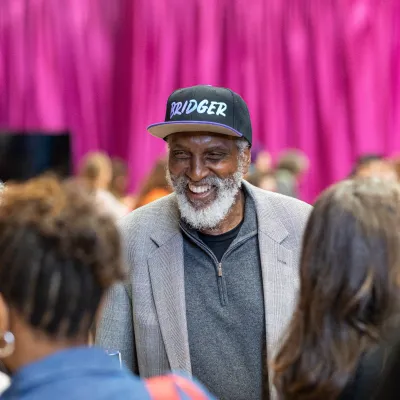
john a. powell
Why are the protagonists of authoritarian ideologies so successful in promoting their worldview? And what kind of stories need to be told to counter this threat to democracy?
More about john powell
“I grew up in Detroit as the sixth of nine children. My father and mother were sharecroppers, which basically was an extension of slavery. Education for black people in those situations was very poor.” This reflection captures what shaped john a. powell into a lifelong advocate for human rights, equality, and diversity. Today, he is widely known as a scholar and intellectual whose work spans law, democracy, racial justice, and social belonging.
Early in his career, powell worked as a public defender in Seattle and, in 1977, received an international human rights fellowship that took him to Mozambique as a consultant to the government – an experience that broadened his global perspective on equity and governance. He went on to combine academic scholarship with advocacy, serving as National Legal Director of the American Civil Liberties Union, founding the Institute on Race and Poverty at the University of Minnesota, and later becoming Executive Director of the Kirwan Institute for the Study of Race and Ethnicity at The Ohio State University, where he advanced research on structural racism, housing, and democratic inclusion.
Today, powell is Director of the Othering & Belonging Institute at the University of California, Berkeley, where he holds the Robert D. Haas Chancellor’s Chair in Equity and Inclusion. His scholarship explores structural racialization, democracy, identity, spirituality and belonging, and he has taught at numerous leading law schools, including Harvard and Columbia.
As a Fellow of the Robert Bosch Academy in Berlin, powell plans to investigate a deeper global transformation. He diagnoses a shift in the foundations of the Enlightenment-era paradigm and the rise of the so-called dark enlightenment. “Its protagonists are the J.D. Vances, the Elon Musks, and the Peter Thiels,” powell says. “Those folks don't believe in equality. They believe some people are superior and have the right to rule.” They promote homogeneity and reject plurality. To counter this ideology there is a need to emphasize “bridging stories” and belonging practices to counter these authoritarian narratives and strengthen democracy.
Berlin and the European context will provide distance from his long-standing work in the San Francisco Bay Area. “I see Europe trying to reinvigorate and reimagine democratic institutions and norms,” he notes. Through exchanges with Fellows, institutional dialogues, and engagement with networks working on democracy and belonging, powell aims to refine a forward-looking framework. The Fellowship is expected to culminate in an outline and early draft of a new paradigm for inclusive democracy in an increasingly polycentric world.
Resumé
January 2012 - present Director, Othering & Belonging Institute, University of California, Berkeley
January 2012 – present Robert D. Haas Chancellor’s Chair in Equity and Inclusion, University of California, Berkeley
January 2012 – present Professor of Law, African American Studies, and Ethnic Studies, University of California, Berkeley
2003-2012 Executive Director, Kirwan Institute for the Study of Race and Ethnicity, The Ohio State University
2003-2012 Gregory H. Williams Chair in Civil Rights and Civil Liberties, The Ohio State University
2003-2012 Professor of Law, Moritz College of Law, The Ohio State University
1993-2003 Professor of Law, University of Minnesota Law School
1987-1993 National Legal Director, American Civil Liberties Union
1984-1987 Professor, University of San Francisco School of Law
john powell's Richard von Weizsäcker Fellowship
During his four-month Richard von Weizsäcker Fellowship, john a. powell aims to explore how societies can navigate a profound global inflection point. He argues that a deeper transformation is underway – one that challenges the Enlightenment-era paradigm that has long shaped modern institutions and democratic societies. According to powell, the so-called dark enlightenment movement and its protagonists have been very successful, relying on the concept of “breaking stories” to instrumentalize people’s fears and anxiety in a changing world.
Building on ongoing research and a draft book project, john a. powell’s fellowship period will focus on developing a constructive path forward. Rather than relying solely on analytical argument, he intends to craft a forward-looking narrative capable of resonating emotionally and culturally, engaging broader audiences and addressing underlying human motivations. This is what he calls “bridging stories.”
By interacting with Fellows, policymakers, and scholars in Berlin and across Europe, he plans to integrate European perspectives and refine a new paradigm for understanding change and guiding collective action. The project is expected to culminate in a structured outline and early draft of a future-oriented framework.