Omri Boehm has a piece of advice for his eleven-year-old son, and it doubles as a self-portrait: If one day the whole class turns on the teacher, even for good reasons, he tells his child, be the one who tells the class to stop. Omri Boehm has been that child all his life: he is an Israeli who argues that his own state should belong equally to Jews and Palestinians. He is the grandson of a Holocaust survivor whose remembrance speech at the Buchenwald concentration camp was canceled after protests by the Israeli government. And he is a man trained inside Israel’s security service who insists that moral law must stand above the state.
Omri Boehm has a name for this instinct, and no embarrassment about it. “Disobedience is always against power. Nobody has the right to just obey,” he says. This stance has left him feeling alone at times, but its roots run deep. It began in the Galilee and was steeped in study, in Kant and the Hebrew Bible. Underneath it is one conviction: that every person is owed the same dignity, whatever their nation or background. As a Richard von Weizsäcker Fellow at the Robert Bosch Academy, he is writing a book to argue that in an age turning back to power, the idealist is the last realist standing.
“The past was always present”
Where does a man learn to defy his own side? And which side, exactly? Omri Boehm bristles at being called a German-Israeli philosopher. “I am nothing but an Israeli,” he insists. Yet even that was never simple. He grew up “half-half”: his father came from a German-Ashkenazi family, his mother from an Iranian-Jewish one. At the time, marriages between Ashkenazi and Mizrahi Jews were extremely rare. “My mother was the only non-Ashkenazi Jew in that commune,” Omri Boehm says. “With time, I discovered that it is much more significant than I had ever realized.”
His German grandmother’s family was killed in the Holocaust. She escaped. As a child, Omri Boehm could see the number tattooed on her arm – “something that my son will not see.” He remembers her as a “woman of Thomas Mann and Schopenhauer.” There was “never an anti-Germany sentiment in her house,” yet “the past was always present.” The lesson he drew from it was not simple loyalty to his own, but a much bigger claim: that dignity is owed to every human being before any nation or group can claim them, his own nation included.
This thought was put to the test in the hardest of places. Straight after school, just before the Second Intifada, he spent his military service in the Shin Bet, Israel’s internal security service. “I am not proud, that's putting it mildly, of being part of an organization that is a center of Israeli violence against the Palestinian people.” After a moment, he continues: “Sometimes the meaning of events is determined by their future.”
“Human dignity cannot accept obedience”
Omri Boehm built a philosophy out of his unease. He wrote a doctorate on Kant, whom he reads as an heir of the biblical prophets, and took one idea from it: real morality and human dignity come from the law you give yourself, not one you merely obey. “Human dignity cannot accept obedience,” he says. “The creature who just obeys is a creature who has in fact agreed to give up on dignity.”
Omri Boehm’s philosophy turns on the same principle he first grasped as a young man: because dignity is universal, no authority, no majority, no state, not even God, may override it. In his first book, The Binding of Isaac, he rejects the usual reading of the story: Abraham’s greatness, he argues, lay not in obeying God’s order to kill his son but in being ready to refuse. He finds the same idea in the first words of Germany’s constitution: “Human dignity is inviolable.” That first article, he argues, describes a human being who does not obey.
“Disobedience is always against power”
For Omri Boehm, everything follows from this universal notion of humanity, and the disobedience it commands. The principle is hard to live by, since it means turning on your own: “Disobedience is always against power,” he says, and recalls the advice he gave his son. “Collective action against power can itself become a form of power and forget very quickly that now it has the power. To be the one who then knows that now the collective has the power, even a collective you belong to, is the most difficult task.”
Omri Boehm’s refusal to embrace power has made him one of the most contested voices on Israel, but he insists it cuts both ways: “The Palestinians are the ones without power. They need our and my protection,” he says – and then challenges Israel’s powerful critics, too: “The voices now driving the argument against Israel have to be called out, too.”
“I find myself alone, surprisingly alone.”
“I want to disappoint both sides. Disappointing both sides is not being a moderate, it is a truly radical alternative,” Omri Boehm says. In 2025, he paid a heavy price for it. Invited to speak at the 80th anniversary of the liberation of the Buchenwald concentration camp, the Holocaust survivor’s grandson saw his invitation withdrawn after the Israeli embassy objected. What wounded him was not the pressure but the hush that followed, he says. Colleagues defended his right to speak, but almost none defended what he had come to say. “No German intellectual came to the defense of those principles. That worried me.” He states the cost without self-pity. “I find myself alone, surprisingly alone.”
What did he come to say? Omri Boehm’s speech was later published in the Süddeutsche Zeitung. “Can we ever prevent forgetting if remembering is not accompanied by an unwavering commitment to peace?” he had come to warn. “The opposite of forgetting is not only knowing the past, but also honoring in the future the duties that this past has laid upon us.” Commemorating the Holocaust’s victims can only mean honoring the dignity of all humans today, he was set to argue. “‘Never again’ is valid only in its universal form.”
“If you just think that having more power will save you, you’re committing suicide.”
The same idea, that universal principles of dignity must govern how nations act, also drives his work as a Richard von Weizsäcker Fellow, aimed now at Europe. He is writing a book against the return to power politics dressed up as realism. “The people who are naive are not the ones who want to keep ideals, but the ones who believe that we can live without them.”
“International law is necessary to protect sovereign states from themselves. The best example is Israel,” Omri Boehm says bluntly. He agrees that Europe needs to be strong in the face of today’s geopolitical developments, “but if you just think that having more power will save you, you’re committing suicide.” Staying true to the philosopher’s disobedience, he urges that the push for strength must not be coupled with less morality. The return to “Machtpolitik” risks repeating the mistakes of the past, he argues. “It is more or less only after the Holocaust that you find dignity in constitutions.”
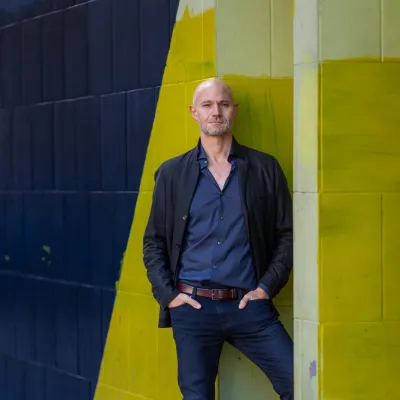
Omri Boehm
Okt. 2026 - Jul. 2027
Can Europe really be strong when it retreats from the ideals of peace and universal human dignity on which it was rebuilt on after 1945?