When Malih Ole Kaunga brings his children to greet their grandfather, the old man does what he has always done. He bends, touches the soil with his fingers, and marks the children with it. It is a small gesture, and to Ole Kaunga it says everything: You belong here. You are part of this land.
This is where any account of his life has to begin. Not with the courts, or the campaigns, or written testimonies, but with the ground itself, and what it means to belong to it. “You are a relative to the land,” he says.
“I didn’t come from anywhere.”
Among the Maasai, he explains, two things bind a person to a place: birth and death. When a child is born, the placenta is buried in the earth, tucked away so no animal can reach it. When an elder dies, they are laid in the same ground. Between those two acts lies a life, and a claim that needs no document. “If you ask a Maasai what proves you own the land, he will tell you, my placenta, my ancestors were buried here. I was born here and underwent my initiation here,” Ole Kaunga says. “I didn’t come from anywhere. This is me.”
Land, in this telling, is not an asset. Its value is belonging, not wealth, “and it carries these memories,” Ole Kaunga says. “My grandmother, my grandfather, my elder brother are buried here. That is legacy.” The ceremonies of a life are fixed to places. “You feel that unique connection between you and space and place.”
“The fence is also about power.”
The bond can be cut, and Ole Kaunga grew up watching it happen. British settlers who stayed on after Kenya’s independence continue to hold tens of thousands of acres behind wire. Born in 1972 and raised largely by his paternal grandmother, Ole Kaunga learned the drought routine early: the cattle had to reach water, and the only remaining source lay on the other side of the settlers’ fences. “My father got arrested multiple times.” The fence, he came to see, was never only about land. The guards had wages and food; the community had neither, and the imbalance seeped into everything around the wire. “It is also about power: through land, and through the ability to have money,” he says. “That’s what shaped my life.”
Then the ground itself turned against them. When Ole Kaunga was twelve, his nine-year-old stepbrother was playing near the family’s water when ordnance left in the rangeland by the British Army exploded and cut off one of his fingers. Others lost their lives in similar incidents.
In 1998, Ole Kaunga began to organize: a petition, signatures, the testimony of families who had lost relatives. British lawyers found him through a newspaper report. He took them to the survivors and the graves, and founded OSILIGI – an acronym for the Organization for the Survival of Il-Laikipiak Maasai Indigenous Group Initiatives, which translates into “hope” in Maa. Together, they took their claim to the High Court in London. The British government settled, further litigation followed. Some 2,400 victims were eventually compensated. “I wanted to prove that injustice can be challenged,” Ole Kaunga says. “I’m not a lawyer,” he adds. “The power I have is with the people.”
“The power I have is with the people.”
If the fence and the ordnance cut people from the land, Ole Kaunga’s work has been to reconnect them to it. In 2013 he started the Camel Caravan, a walk along the Ewaso Ng’iro, the great, drying river of northern Kenya. Communities that used to fight over water and pasture came together. In 2025, eight of them declared a commitment to end conflict. Every year now, between 800 and 1,000 people walk the caravan, which ends on 9 August, the International Day of the World’s Indigenous Peoples. “We use the river, and we use culture, to weave people together and build peace,” Ole Kaunga says.
The bond also carries to the young. The Indigenous Movement for Peace Advancement and Conflict Transformation (IMPACT), which he founded in 2002, today employs more than 70 people, most of them under 30, many educated in Nairobi. “They come for a job,” Ole Kaunga says. “But over time they get reconnected with their land. The passion comes back.”
“Being in this fellowship is a sanctuary for me.”
Over the years Ole Kaunga has become an institution. In Kenya, if a question touches land, Indigenous rights or injustice, the road leads to him. “If anything happens, it is: let’s talk to that guy,” he says. Even during this conversation, word arrives that elders somewhere are waiting. His office, he says, is less an office than a reporting station.
It costs him something few people see. “There is a lot of emotional injury in this kind of work,” he says. And there is an inequity he states without drama: “If I was a white person doing this kind of work, I would have won so many awards. I would have been known globally.” As it is, “people know my name, but not me.”
Which is why his Richard von Weizsäcker Fellowship is more than a work residency. “Being in this fellowship is a sanctuary for me,” he says. He is using it to reflect and to listen, to civil-society groups, to philanthropists, to climate initiatives. And even here he goes looking for trees. What he values about Berlin is its green spaces: the small park nearby, or the Tiergarten, where he goes to think and to work.
“Nobody is talking about sharing the profit.”
Climate change reaches his community first as a change in the land, and it is read in the old vocabulary. “They will never say ‘climate change,’ they tell you about the land, the water, the ceremonies,” he says. “When the donkeys start dying, this is a terrible drought.”
What alarms him is what arrives in the name of the cure. Conservancies, carbon reduction projects, wind and geothermal schemes are being laid over the same Indigenous rangelands, and they change the relationship. “People start becoming transactional with their land.” The ground becomes a source of money rather than a relative. “It is another gold rush,” he says. “Nobody is talking about sharing the profit.”
How inclusive is inclusion?
His fear is that as more land is enclosed, “there will be no land for food.” And what enrages him is the refusal to see that pastoral systems are already a conservation model. Instead of yet again imposing decisions on Indigenous communities, it should be left to them to shape the stewardship of land and nature, Ole Kaunga says. “These communities are already doing that. Because when they move livestock, it’s a way of sequestering. You are spreading seeds, you are spreading health, you are maintaining balance between different ecological zones.”
The question he brings to the Robert Bosch Academy is whether the shift to clean energy will be genuinely inclusive, and who decides what inclusion means. He approaches land not as a technical policy problem but as a site of rights and belonging. And he is testing an alternative, one in which the people who belong to the land become shareholders in its future. “I’m not just criticizing,” he says. “I’m giving a solution.”
Power – and peace
Ole Kaunga moves between two worlds, the conference room in Berlin and the village on the drying river, and he carries the same conviction into both: that the ones who belong to a place should be the ones to decide its future.
Ask him where power lies, he cites the many changes already achieved: “There is hope in action. There is a lot of hope in communities working together and defending themselves. I see the level of transformation.” Ask him where he ultimately finds peace, he takes you back to the savannah he comes from, to the storytelling in the villages, and to the soil his father presses onto his grandchildren’s foreheads. “I didn’t come from anywhere. This is me.”
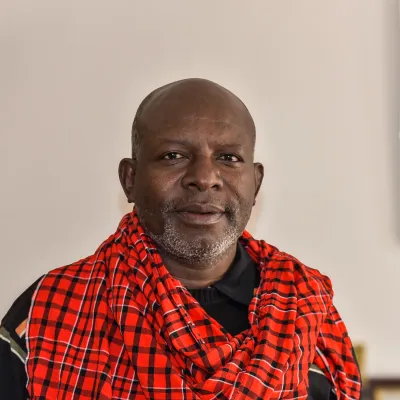
Malih Ole Kaunga
March – August 2026
“Can the shift to clean energy be just, when it rises on the same lands once taken from Indigenous communities? What does inclusion in climate policy really mean, and who gets to decide? And how can decision-making power, and money, finally reach the people already sustaining these ecosystems?”