The Next Question
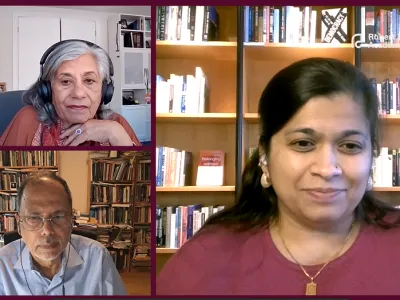




In the second episode of The Next Question, Pradnya Bivalkar interviews policymaker The Honourable Ratna Omidvar and historian Dipesh Chakrabarty. She asks who belongs, on what terms, and whether the ideas of belonging we have inherited still fit the societies we are becoming.
Watch the full episode, learn about the guests and host, and read the transcript below.
The Next Question on Belonging: Watch the full episode
Meet the Guests: Ratna Omidvar and Dipesh Chakrabarty
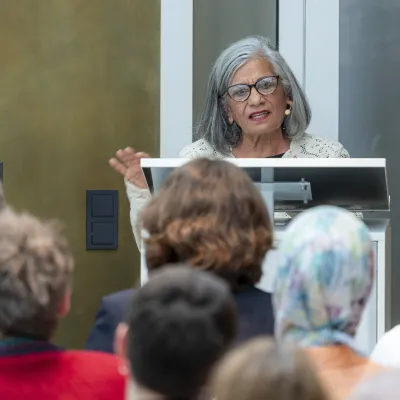
The Honourable Ratna Omidvar
Policymaker
Ratna Omidvar has built and led organizations at the intersection of civil society, policy, and research, all aimed at improving immigrants' access to education and the labor market, and she served in the Senate of Canada. She is a Richard von Weizsäcker Fellow and was appointed to the Order of Canada in 2011. She received the Cross of the Order of Merit of the Federal Republic of Germany in 2014 in recognition of her work on behalf of immigrants and integration.
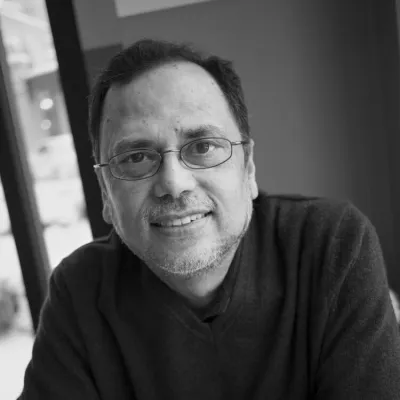
Dipesh Chakrabarty
Historian
Dipesh Chakrabarty is the Lawrence A. Kimpton Distinguished Service Professor of History and South Asian Languages and Civilizations at the University of Chicago. Born in Kolkata, he taught in Australia for twenty years before moving to the United States. His book Provincializing Europe is a foundational text of postcolonial and subaltern studies. His recent work, including The Climate of History in a Planetary Age and One Planet, Many Worlds, argues that climate change requires us to see ourselves from two perspectives at once, as a global and as a planetary species.
Meet the Host: Pradnya Bivalkar
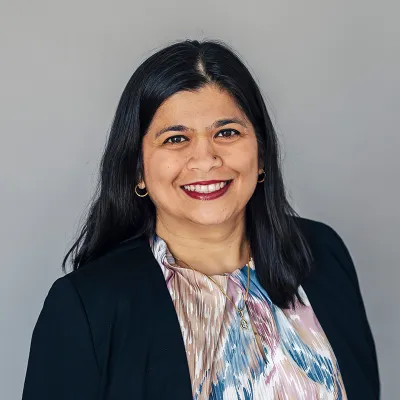
Pradnya Bivalkar
Senior Project Manager
Pradnya Bivalkar is Senior Project Manager at the Robert Bosch Academy in Berlin and works with the Richard von Weizsäcker Fellows. Her areas of work include Identity Conflicts, Political Systems, Modern India, and the Global North-Global South Dynamic. She has hosted the Academy's podcast since January 2023, first as Think. Debate. Inspire. and now as The Next Question.
Transcript of conversation with Ratna Omidvar and Dipesh Chakrabarty
Pradnya Bivalkar: When we talk about belonging, we inevitably touch on questions of identity, citizenship, migration, integration, and so much more. But these questions are becoming more complex as our societies and circumstances change.
In our earlier conversation, Ivan Krastev spoke about demographic anxieties and how a sense of loss and anxiety around my world dying and your world staying, is fueling a renewed political struggle over who belongs, who gets recognized as part of the collective us, and a renegotiation around belonging. This belonging also comes with its own history, constructed around nation, community, religion, and so on.
So today, I want to explore, together with Ratna Omidvar and Dipesh Chakrabarty, the question of not only who belongs, on what terms, but also whether the historical ideas of belonging that we use are suitable to understand the societies we are and are headed towards becoming.
Welcome to the podcast, Ratna and Dipesh.
When you think about belonging, what are the three words, contexts, or concepts that immediately come to mind?
Ratna Omidvar: Thank you for that question. I like alliteration, so I will use three words that start with "E." Belonging is emotional. Belonging is elusive. Belonging is essential.
For me, the emotionality of belonging is perhaps not given enough space in this discussion because we think of belonging as being transactional: Integration is belonging; no, it's not. We think about citizenship as being belonging; no, it is not because you can be a citizen and still be excluded. And whilst you can have legislation that moves the yardsticks in this way or that way, legislation doesn't change attitudes. It can impact behavior – because behavior is legal, illegal – but attitudes are a completely different thing. And as someone who is an immigrant to Canada – and I have lived here for 40 years – it is also elusive because there are parts of the history of a country you don't quite grasp when you haven't lived there throughout your whole life.
I'll give you one example. It was only when I became a parliamentarian and went to Ottawa that I realized the complexities of Indigenous history and culture. I live in Toronto. I'd never met, frankly, more than a handful of Indigenous people. So for me, it is also elusive. It's not a set construct. It evolves, morphs, shifts, and changes back again and again.
And of course, finally, I think it's essential because we are not islands unto ourselves. We live as part of a bigger whole, whether that's a national construct or regional, or I would say it's more local than anything else.
So those are my three words to put on your table.
Dipesh Chakrabarty: So if you would allow me to use four words – I tried three and then I realized I needed four. I would say in my case: Bengali, South Asian, global, and human ape, human hyphen ape. Those would be my four words.
PB: So I realize already at this point that we are going to have very different vantage points from which to access the conversation. Like I said, the conversation is framed around the next question, and we want to go beyond the here and the now, moving away from responding to the present to imagining a future.
That's a big jump that we have to manage. So let me start with you, Dipesh. Your work has extensively looked into the histories of belonging.
Looking at the future from that vantage point where you start, what is the next question on belonging that we should be asking ourselves?
DC: What worries me these days is that humans are collectively failing to address problems that at a very high level of abstraction are actually problems of belonging that they also collectively face. So, climate change, AI, the generally falling human birth rates – the UN predicts that we'll be an aging and urban species by the end of the century.
And the growing inequality, the fact that you now have super capitalists who don't seem to have any interest in democracy in different countries, not just in America, also in other countries. And these four things worry me because they are ultimately questions of human futures, how we live with one another. And the questions of anti-migration fears, the provocation of those fears, the exploitation of those fears are part of this problem.
A lot of things are changing. The baby boomer history that I was part of, have been part of, is coming to an end. And there are human stories we told each other during the baby boomers', during our lifetime – peace, no war, the UN international order should hold – that aren't holding. So there are all these uncertainties, which can be described as political uncertainties, but they are for me, at a deep philosophical level, also questions about how to be human in the face of these uncertainties and therefore how to belong here to the planet, to each other, as human beings.
PB: Ratna, would you like to come in on that?
RO: I think of the new boundaries that are being imagined on belonging. So for me, the question really is, as we redefine identity, how will belonging be renegotiated in the construct of new identities? Let me give you a little bit of context here.
In North America and in Europe, ancestry is being put forward as an imagined baseline for belonging. It has always to some extent been the case in Germany, because you've had Germans by birth, whether they were born in Germany or came from elsewhere, they were Germans because they were Germans by birth. That is actually somewhat contradictory to our context in North America, because in North America, we like to say, "Give me your poor, your huddled masses, et cetera, et cetera," that really romantic story.
And yet today, there is a certain nostalgia for traditional modes of defining who belongs, who doesn't belong. Just as one example, this romanticism about the tradwife movement. And I recently read about new terminology relating to so-called heritage Americans, which would exclude, obviously, the Indigenous peoples of the United States and its immigrants. So I think all of this is being put on the table.
I will simply quote our prime minister, who in another context said, "Nostalgia is not a policy." Societies evolve. It's impossible to go back. You only move forward. But as these new identities are being put on the table in many parts of the world, then the question really becomes, how will belonging be renegotiated within these new boundaries?
So let's just take Sachsen-Anhalt and Dipesh, I'm sorry, I come at this from a very political point of view because I am a recovering politician. If the re-migration policies of Sachsen-Anhalt are really implemented, then longstanding structures of belonging, the efforts that communities and individuals have put into this, will be gone. Perhaps not in a nanosecond, but they will be gone.
What are the guardrails? Who puts them on? Who imagines the guardrails?
We're living in a new reality. Same old, same old is not working anymore. We have to think, we have to imagine belonging in a different way.
I don't think I have all the answers to what that question could lead to, but I think that is the question.
PB: I was listening to a podcast with Anton Jaeger, who talks about the hyper-politicization of things and how being a part of populist politics gives people a sense of belonging. If you look at the voter turnout for Sachsen-Anhalt, it was quite impressive. A lot of people turned up to cast their vote.
These were people who probably had not been a part of the conversation for a long time. It gave them a sense of belonging, just based on a completely different set of assumptions. This was belonging with exclusion at its core, and the belonging that we are talking about has a slightly different approach. We are looking at a belonging in a broader sense, without the necessity of excluding someone. We are looking at a belonging which allows people to be multiple people at the same go.
Do you think right now the whole conversation around people feeling a sense of belonging in the elections has more to do with their need to want to matter in a society?
RO: I think that's actually the hub of the conversation. Whether we like what the far-right in Germany or in other parts of the world is doing, perhaps is not the question. I think it's an example of how people actually move from being individuals, possibly isolated individuals, to becoming part of something that is bigger than the whole.
And for me, that is through movements. When people join movements, they become part of something. Whether that movement is to unseat a government or to agitate to plant some trees in a park, it's a movement.
It gives you a tangible outcome that you can take pride in and own. Now, in the classical literature of belonging, one of the significant indicators that is used relates to ownership, because this is all about ownership, but it rests on home ownership. So the assumption is you buy a home, you have ownership.
I can tell you stories about suburban Toronto where there are huge developments in the suburbs that are either completely Punjabi or completely Chinese as the demographic trends go. That is not belonging. For me, I think belonging is about being something bigger than you.
The populist movement actually exemplifies what I'm saying quite accurately. These are people who felt, from what I read, who felt excluded, who felt no one was paying attention to them, whose prosperity did not match the rest of the country. And so they chose to paint a picture of an enemy, a common enemy.
And that common enemy was the immigrant. I'm just talking about a political strategy that seemed to meet the moment for that particular moment. Now, the question really is, what do the rest of us do to counter that strategy?
I think we have to paint a picture of people – who are not traditional in that sense in Germany – we have to paint a picture of them as my friend. That's what we have to do.
And we have not started to do that.
PB: Dipesh, what do you think?
DC: I should clarify, see, because Ratna speaks as a political person and a politician, and I don't. So I'm very much, in my 40 years of teaching and probably 45 or 50 years of being an academic, my question has gone from specific historical questions and how do I fix this problem to a sense of wonder and puzzlement about what being a human means. So I love the, as an intellectual, I love the ironies, the contradictions, the tragedies that attend human endeavors.
And that's what I think about. So I'm not a fixer. I don't fix things. I think of myself as just sitting on the bank of the human river and watch the river go by.
PB: Lovely philosophical framing to what Ratna was talking about. And because this conversation also involves a lot of imagination, focusing on the future, about where we are headed. If you were to use your metaphor of sitting on the banks of the river and watching where the conversation is headed – you in some of your work have also spoken about how we learned to have an imagination of belonging.
So how do we learn that we all are a nation together? That it's not preconceived. That over a period of time, there is an imagination that finds its footing and takes hold.
If I were to ask you what kind of imagination should we aspire towards to have an inclusive imagination of belonging, what would your answer be?
DC: So my answer would be that we all belong to overlapping circles or ellipses or however you imagine the spheres, three-dimensionally, of belongings. We all do. So I think given all the crises that Ratna was talking about, I think the most urgent need is to remind ourselves of our humanity, knowing philosophically that human beings are always prone to doing something horrible.
PB: The imagination of belonging has multiple levels and I think one aspect that I know that Ratna is also very keen on exploring is the language around belonging because language as a tool has a lot of power.
Ratna, what are your thoughts on how can we re-imagine the imagination around belonging?
RO: Yeah, thank you Pradnya and thank you Dipesh. I was taken by the image you evoked of a river and you're sitting on the river, on the banks of the river and you're watching it flow because you're an observer, an academic. I'm the complete opposite. I need to be in the river. I need to swim in it. I need to get to the end. So I think this is an interesting dynamic.
Language is at the heart of culture. There's nothing quite like language to give as a mirror to the hearts and minds of people. The language you use, whether it's English or German or Bangla, it is the language that reflects the culture and personality of a people.
And language also shifts and changes and evolves. I remember the time when there were only two genders and now there are multiple definitions because society has evolved. Its edges have become more porous and less hardened as the tent, the big tent that we are all in has.
And I like the image of a tent or of a circle because it can always expand. And I think the gender example is an appropriate one.
In North America, or at least in Canada, I won't speak for the United States – can't pretend to anymore – the language we have always used is, "new Canadians." You're not "new immigrants." You're Canadians and maybe you're a "new Canadian" or a "newer Canadian."
Sometimes people refer to me as a "newer Canadian," although I've been a Canadian for 40-plus years. I actually like that because I do think as a human being, you know, Dipesh talked about his sense of loss. I completely agree with that. I think people like Pradnya, Dipesh, we live in the gray world, the in-between world. We're neither here nor there.
When I go home to India, I love it. I love the chaos and the noise and the crowds. Within a week, I want to come home. So you are and you aren't.
So I think language is the mirror and the definitions you use, the labels you use are an expression of the evolution of belonging. Gender is one example. New Canadians is another.
In Germany, you have a "retro" definition of belonging, which is legislated or normalized in your language. There are two kinds of Germans: there are Germans and then there are Germans with an immigration history, regardless of whether that history goes back two or three generations in Germany. It doesn't matter. There are two kinds of Germans. I think we need to imagine one kind of citizen.
At the global level, I agree with Dipesh wholeheartedly. A global citizen, we need to be a global citizenry, but I'm not pollyannish either. So I like to anchor the essence of belonging in spaces that are local and then maybe national and then maybe global.
Of course, in Germany – I was in Berlin for four months – I realized how important the regional was, which is kind of different for me. I'm either Toronto or Canada. I'm not Ontario. But in Germany, and I think maybe in the United States, it might be a little different.
So, you know, getting back to your question, language is the mirror to the heart and soul of a people.
DC: The immigration story is extremely rich and it contains these stories of losses and gains, stories of contraction of some part of your life and expansion of another. I mean, I have gained so much and lost so much, but also had 20 years in Australia before my 31 years in America. I mean, Australia was totally formative.
It's another country that I relate to in a deeper way because I came to America as a full professor, a professional. I only know universities mostly, but in Australia, I knew a broader cross-section of people, including some Aboriginal people, and that was tremendously life-expanding. So I think we live through these things and probably Ratna and I are on the same page, that these losses sometimes take life-threatening forms for others, but these losses sometimes result in beautiful poetry, films.
So I think the question is, how do we teach human beings – I say this as a teacher – ourselves and our next generation, to carry with them a sense of this multiple levels and ways of being human, which also make us inhuman? And to be always aware of the story of the risk that being human means carrying the risk of becoming inhuman?
PB: That's a brilliant way of bringing this much bigger question into the context.
Today's conversation was a lot about imagination, things that inspire us, things that make us worried. So if you were to think of a particular piece of art, a book, a film that you have come across that inspires you, that prods you to think, can you what would it be?
DC: I had actually thought of both the book and the film called The Namesake by Jhumpa Lahari, but after this conversation, I'm going to shift. The book that really is relevant, along with The Namesake, to what I'm putting on the table in terms of belonging is an author called M.G. Vassanji, who wrote The In-Between World of Vikram Lall, an absolutely stunning book of three boys, three young boys who live in, I think, Tanzania. And for them, race, social status, education are no boundaries to their friendship.
And they have this incredible friendship, which then gets torn apart by the waves around them. And to me, that was so poignant, because to me, it tells me we need to go back to the innocence of our childhood to find the way forward, because there is a way and children teach it to us. And when we grow up, we leave that behind.
I think – you know what? – I'm going to read it again as a result of this conversation.
DC: First of all, I want to thank both you, Ratna, and you, Pradnya, for having this conversation with me. I gained a lot and enjoyed it very much. And it turns out we have more in common, actually, than our the immediacy of our professions seem to separate us.
PB: A different sense of belonging.
DC: Yeah, but we have all those multiple senses of belonging. And for me, I just want to say that at some level, when I think archaeologically or geologically of my life, and I think of strata, right, layers going down, then my deepest layer is what I might call Bengali. And by Bengali, I include Bangladeshis and West Bengalis.
And there, there's a writer who I've always returned to, and he still is – all his books are here on my right-hand side: Tagore, who works as an inner compass for me. And if that needle is showing I'm going the wrong way, I try not to go there.
I've grown up with him – his centenary years was '61, I was in high school. And his songs – I'm speaking from the bottom most layer. And the bottom layer of Bengali includes, of course, Turkish words, Persian words, Arabic words, English words, Portuguese words, Dutch words.
The cards we play have Dutch names, right? We don't even know that they're Dutch names. So don't hear it as a language of being monolingual. In today's world, every language is internally plural, because they're borrowed from other languages and enrich themselves.
PB: That connects the dots to what Ratna also spoke about, about the language element of belonging, which is a very strong one. So thank you so much for joining me for this conversation.
It was a pleasure to have both of you. And thank you to the audience for listening. Until next time, keep asking the next question.