For Marija Golubeva, Europe is not an abstract project, but a room that allows freedom for multitudes of people and ways of living. "I see Europe as a safe space where people can exercise their individual agency and their ability to be themselves,” she says. As a Richard von Weizsäcker Fellow, she focuses on what puts this project at risk. “I do think European democracy is in genuine danger,” she says. “Hybrid pressure is something that is very, very dangerous because it might break us as Europe even without a single Russian soldier on our soil.”
The impact of hybrid threats – especially Russian disinformation, sabotage, and cognitive warfare – is something Marija knows all too well. As Latvia’s Minister of Interior, she saw how quickly these attacks eroded the civic trust that holds open societies together. After having guided Latvia through hybrid attacks – and becoming a target of them herself – she is certain: Europe’s response must combine resilience with deterrence.
From reformer to target
Marija Golubeva entered parliament in 2018 as co-founder of Movement For! (Ķustiba Par!), a liberal, pro-European party that deliberately rejected Latvia’s ethnopolitical fault lines. As Minister of the Interior from 2021 she got to work reforming police education, leaning on her skills as a policy analyst and her ability to account for and respect the views of diverse stakeholders to bring about much-needed change.
Then came August 2021. Belarusian dictator, Alexander Lukashenko, faced an ever-growing list of EU sanctions following his brutal crackdown on anti-government protests. Seeking retribution for the EU’s refusal to recognize the results of the sham elections held the year prior, he decided to aggravate the EU’s Achilles’ heel: migration.
Seemingly overnight, the price for flights to Minsk from West Asia decreased to as little as 20 EUR. Word quickly spread on social media and people seeking an alternative to the perilous journey across the Mediterranean purchased them in droves. On a map, the route looks easy enough – land in Minsk, take a bus west, cross into Lativa, Lithuania, and Poland. But in reality, Lukashenko set the stage for humanitarian catastrophe, stranding dozens of families deep in the forest. As Latvia’s Minister of the Interior, Marija Golubeva was in the thick of it.
On her plate was a series of impossible decisions. Letting everyone through would invite Belarus to again and again instrumentalize people trying to get to Europe; doing so also risked inflaming domestic tensions, as had happened in 2015; to complicate matters further, the countries would need to respond collectively; and they would need to do so in a way that reflected Europe’s values. The results were mixed.
“I was not satisfied with how little space our collective decision – meaning that of Latvia, Lithuania, and Poland – left for taking a case-by-case approach,” Golubeva reflects. “I preferred a solution that would have allowed some kind of legal channel for people to apply for asylum in the European Union without being admitted wholesale to our territory.”
Russia launched its full-scale invasion of Ukraine at the heels of this border crisis. When Ukrainian refugees arrived in Latvia in great numbers, Marija made sure she stood up for allocating more funds for housing and support. “That was not easy to achieve,” she says. “I was losing support, I was losing allies in the coalition, but I just couldn't imagine that I would do anything else under those circumstances.”
Before long, Marija was on Russia’s wanted list. By May 2022 she was gone from her office in the Ministry of Interior. A gathering of Russian speakers at Riga’s Soviet Victory Monument had given excuse for a nationalist coalition party to present an ultimatum that she should leave. The Prime Minister yielded. “What does it say about Latvian resilience if an insignificant gathering of a few hundred people standing for two hours can shake the government?” Marija Golubeva commented in her final press conference.
Only later, studying hybrid threats, did she recognize the pattern: “About five or six months before elections, individual politicians in leading positions who are perceived as vulnerable start being attacked en masse on social media. I had no idea that it wasn’t just by chance.” From the manufactured crisis at the Belarusian border to her being pushed out of office, hybrid warfare was everywhere. It colored not only her experience as a policymaker, but also the very pressures Latvia and Europe were being forced to face.
Equipping Europe to handle today’s complex crises
It is not quite correct when we say that hybrid threat actors spread disinformation, Marija Golubeva argues. “What illicit campaigns target is not information, but behavior.” She describes an increasing phenomenon: In the first minutes after any unexplained incident – a drone, an explosion, a closed airport –, the information space is flooded with manipulated information before any official version exists. The goal of these interventions through fake news sites and bot networks – driven by Russia and other actors – is not to convince people of something specific but to undermine people’s trust in their governments and European institutions.
And that is especially easy to do when Europe’s institutions face multiple crises. Europe is often on the backfoot, “scrambling to solve the issues instead of having a clear, prepared plan for how we're going to deal with such challenges,” Marija stresses. “Whenever there's double pressure on a government or on European institutions – for example Spain was facing the fires and then the manufactured crisis at Ceuta took place – policymakers really struggle to make decisions.”
Today, she runs crisis simulations through her digital platform Meleys to test exactly these gaps. “One thing is reading about a situation and thinking, ‘Oh, well, we should probably respond like this.’,” Marija says. “It’s another thing when you're thrown into the situation, when you know you have to make those decisions, and the pressure is mounting.”
“My attitude towards policy work has always been: try to change something where you think it matters.”
A plan for trust
The lessons from these simulations go further than individuals’ preparedness. On a local level, as well as a European level, lack of trust makes it harder to make good decisions. Developing a basic blueprint for how to respond to hybrid attacks and multiple crises might help bridge this gap – right now, such a blueprint doesn’t exist. “You have to have some kind of agreement on how we share resources, how we share data among different EU countries, how we make decisions jointly and quickly – you cannot just improvise,” Marija says.
Devising such a framework for decision-making is easier said than done. However, Marija is using her Richard von Weizsäcker Fellowship to explore how European countries can best work together to counter hybrid threats – and preserve the European project.
When asked if we might not be too late, she is determined: “There is always hope for this project. But sometimes you have to go through a pretty dark forest. And it’s better if we manage to build bridges over the worst precipices.” She is, she adds with a slight smile, “just one of the very small bridge builders.”
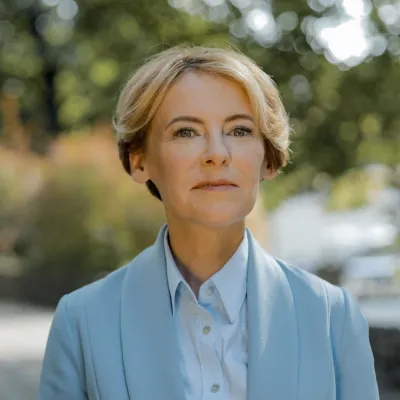
Marija Golubeva
July 2026 – December 2026
How do we build the resilience and deterrence needed to defend the European project from hybrid attacks?