When Julia Cimafiejeva arrives in a country whose language she does not speak, she knows where to go first. “I go to the bookstore just to feel at home,” she says. “To see the books, that the world is normal.” Since she left Belarus with her husband, the writer Alhierd Bacharevič, in November 2020, she has needed that reassurance often. Exile took them to Graz, Chemnitz, Zug, and Hamburg. “This life felt like living on a train,” she says. In Minsk, they left a big library behind. “We came with two suitcases and two backpacks.”
“Some big black train crashing”
Julia Cimafiejeva was born in 1982 in Śpiaryžža, a village in the Brahin district of southern Belarus. Her mother was a nurse, her father a builder. She was four when Chernobyl’s nuclear reactor exploded, not far from where the family lived. The firefighter whose widow opens Voices from Chernobyl, the oral history by 2015 Nobel laureate Svetlana Alexievich, came from Julia’s home village.
That Sunday, the family was on the road when the rain caught them. “We got under the rain, under these contaminated clouds,” Julia Cimafiejeva says. “We got wet to the skin.” At home, her mother washed the children and threw their clothes away. The next day, at kindergarten, she overheard the teachers talking about a catastrophe. “I remember imagining some big black train crashing.” Outside, men in white suits measured radiation while the children played in the sand.
As a girl, she wanted only to leave. “I wanted to be in a big city, to be a big-city citizen,” she says. “But now I can’t but write about that, because that’s inside of me.”
“Sweet on my tongue”
In the village, she grew up with trasianka, the countryside mix of Belarusian and Russian. In the city, she switched to Russian, and later to Belarusian. “For me, it’s very sweet. Not too sweet, but sweet enough to be pleasant,” she says, and she means it physically. “I speak about physical sounds that you produce with your mouth and not that you hear. So it’s sweet on my mouth, on my tongue.”
In Belarus, she says, no one can avoid the question of language. Although Belarusian became the sole state language in 1990, Russian was given equal status in 1995, and it dominates public life. “You always have to choose,” Julia Cimafiejeva says. Politics aside, Russian also comes with the weight of Dostoevsky, Tolstoy, and Chekhov, she says. The Belarusian classics, by contrast, did not shape her: “I feel much more free in this language. I can do whatever I want.”
“These translations are like mirrors”
Julia Cimafiejeva studied English in Minsk and, in her mid-twenties, began translating Walt Whitman, Stephen Crane, and Sylvia Plath into Belarusian. “I had to invent another poetic language for these texts,” she says. “And having invented this language, I decided that I could make it mine.” That is how she came to her own poetry. Translating Paul Celan, she read him in every language she knew. “These translations are like mirrors. When you go into this tunnel of mirrors, there is the text, and you try to understand or interpret it through these mirrors.”
„The Stone of Fear“
Her grandfather was born in 1913. His life spanned the Stalinist purges, collectivization, the Second World War, and Soviet rule. Her poem “The Stone of Fear” is about what such a century leaves behind: “One by one, we feed this stone,” the poem reads. “When you are Belarusian, you always have to be on alert,” Julia Cimafiejeva says. “You always have to have this fear in front of you, like it’s your weapon.” She was taught to be silent by her parents: silence was “an instrument of survival.”
In 2001, she joined her first protest against the authoritarian regime of Alexander Lukashenko, who has ruled Belarus since 1994. In the following years, an independent cultural scene grew alongside the state. “The state didn’t believe that this kind of culture could influence society,” she says. “But the opposite happened.” In 2020, protesters carried quotes from Belarusian literature through the streets.
Days before the presidential election, she wrote “My European Poem” in English. “I could not tell it in Belarusian, because I would be a laughing stock.” In English, she could imagine “belonging to a nation that hasn’t failed so much.” Once more, Belarus did not register in the international headlines. “That was my cry for the foreign audience.” The protests were violently suppressed. In November 2020, she left the country.
“Without this label, I’m almost invisible”
In Germany, she is often invited as a writer in exile. “Without this label, I’m almost invisible,” she says, but she does not want it to define her writing. “Language cannot be in exile. Language just exists. A person can be in exile, or there can be texts about exile, but language cannot be like that.” Exile itself, she says, is “this journey with no end,” and it has changed her. One of her collections is called ROT, the Belarusian word for mouth. “What I’m writing mostly about is making something heard,” she says, “and that I should voice that with my mouth.”
Her latest poetry cycle, Blutkreislauf, follows her family across a century. With her husband, she traveled to the places in Germany where her grandfather and a great-aunt had been forced laborers. “Sometimes I believe that you can write only about something that is dead or that is dying,” she says. Writing the book “was also like speaking to my ancestors.” In 2026, it was shortlisted for the Internationaler Literaturpreis and won her the Hilde Domin Prize for Literature in Exile.
“Who are Belarusians then, if not Europeans?”
As the first fellow from Belarus at the Robert Bosch Academy, Julia Cimafiejeva asks why Belarusian stories are still missing from Europe’s literary landscape: “There is Eastern Europe, and it’s Russia and Ukraine. No Belarus,” she says. “I’m fed up with that. And that’s why I took this topic.” Belarus, she says, has always been part of Europe. “Who are Belarusians then, if not Europeans?”
During her fellowship, she met decision-makers in politics, academia, culture, and civil society in Germany and across Europe to make Belarusian culture and its stories more visible, “at least a bit,” as she puts it. In Berlin, she says, she does not have to tell the story of Belarus – an “unfree country” – from the very beginning.
“Hope is not the thing that I use now”
What keeps her going are the Belarusians of the twentieth century. “Belarusian culture was made by crazy romantics, naive, very naive people, who went on doing their things because they believed in that,” she says. “Maybe they didn’t have hope, or maybe they had hope, but it never turned out during their lifetime. But still they were doing this thing. And that’s maybe what I’m doing.” Literature, she goes on, may not change minds. “But still it helps people to float in this sea of insecurity and violence.”
Berlin, she says, reminds her of Minsk. “It’s about being safe to be who I am.” Asked for a song that has stayed with her, she first chooses silence. “I’m talking so much,” she says. Then she finds an answer: “Let it be the sound of the night rain. In a big city.
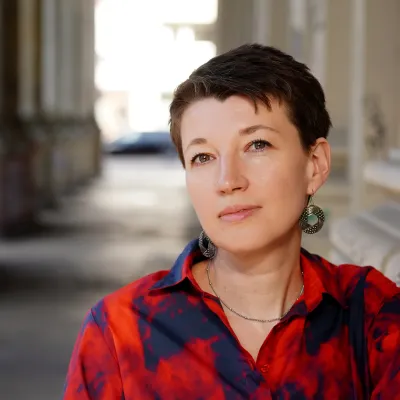
Julia Cimafiejeva
Feb. 2026 – June 2026
What will it take for Belarusian narratives to become part of Europe’s cultural landscape?