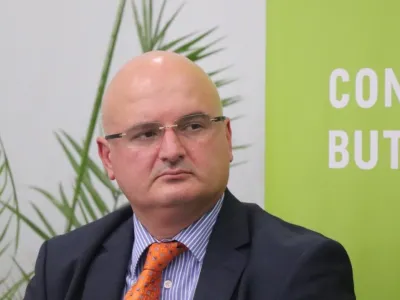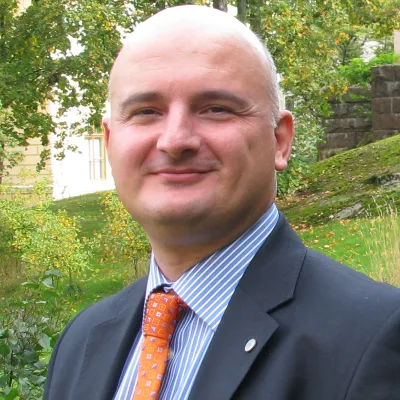
Kornely Kakachia
Why does Europe still underestimate the strategic value of Georgia and the wider Black Sea region? And what would it take for Germany and the EU to engage seriously and stay the course, before competing and authoritarian powers fill the space they leave behind?
More about Kornely Kakachia
Kornely Kakachia has spent his life trying to help Georgia become, and remain, a democracy inside Europe through the power of independent political analysis and debate. Born in 1971 in a provincial town in western Georgia and raised by his mother after his father died in his infancy, he came of age as the Soviet Union collapsed. He belongs to the first generation of Georgian political scientists, who built the discipline in a university that still taught scientific communism, while the state itself had to be invented from scratch.
To establish himself without joining a party or paying a bribe, he spent ten years at the UN before returning to academia after the 2003 Rose Revolution, with fellowships at Harvard and Columbia. In 2011, he founded the Georgian Institute of Politics (GIP), the country’s leading nonpartisan think tank, and built it into a respected voice tied into European research networks. He is Professor of Political Science and Jean Monnet Chair at Tbilisi State University, and one of the foreign press’s most-quoted interpreters of Georgian affairs.
Today his institute is shut under a Russian-style foreign-agent law, and Georgia is sliding from its Western path against the wishes of most of its people. As a Richard von Weizsäcker Fellow, Kornely Kakachia examines the security and connectivity of the Black Sea region and Europe’s engagement with its eastern flank. His central argument is that Georgia and the wider region are far more strategically important to the EU than Brussels and Berlin recognize, and that if Europe does not engage seriously and consistently, others will. A new set of players is moving into the space, from Russia and China to Iran and the Gulf states, and they do not attach the democratic conditions Europe does.
Last updated: 2026
Resumé
2024 – Publication (ed.): Security Dynamics in the Black Sea Region: Geopolitical Shifts and Regional Orders (Springer)
2023 – DAAD Visiting Research Fellow, Centre for European Policy Studies (CEPS), Brussels
2022 – Publication (ed.): Georgia’s Foreign Policy in the 21st Century: Challenges for a Small State (Bloomsbury)
2019 – Erasmus Mundus Visiting Professor, University College Dublin and Freie Universität Berlin
2018 – Publication (ed.): Geopolitics and Security: A New Strategy for the South Caucasus (with Stefan Meister and Benjamin Fricke; KAS, GIP and DGAP)
2018 – Visiting Lecturer, Institute of Geopolitics, Paris 8 University
2017 – Publication (ed.): International System since Westphalia up to the End of Bipolar System (in Georgian; Universal Publishing)
2016 – Publication (ed.): Values and Identity as Sources of Foreign Policy in Armenia and Georgia (with Alexander Markarov; Universal Publishing House)
2015 – Visiting Researcher, Friedrich Schiller University Jena
2014 - present – Professor of Political Science (Jean Monnet Chair, 2022–2025), Ivane Javakhishvili Tbilisi State University
2013 – Publication (ed.): Role of Social Networks in Georgian Party Politics (with Tamar Pataraia; Meridiani Publishing)
2013 – Publication (ed.): Georgian Foreign Policy: Quest for Sustainable Security (with Michael Cecire; Konrad-Adenauer-Stiftung)
2011 – Visiting Scholar, Harriman Institute, Columbia University
2011 – Founder and Director, Georgian Institute of Politics (GIP), Tbilisi
2010 – Visiting Scholar, Aleksanteri Institute, University of Helsinki
2009 - 2010 – Visiting Fellow, Black Sea Security Program, John F. Kennedy School of Government, Harvard University
2005 - 2010 – Director, School of Politics and International Relations, University of Georgia
2002 – PhD in Political Science, Ivane Javakhishvili Tbilisi State University
2000 – Research Scholar, Johns Hopkins University SAIS, Washington DC (IREX Contemporary Issues Fellowship)
1994 - 1997 – Postgraduate studies in Political Science, Ivane Javakhishvili Tbilisi State University
1994 – Visiting research student, Foreign Policy Institute, Johns Hopkins University SAIS, Washington DC
1990 - 1993 – Diploma in Law, Ivane Javakhishvili Tbilisi State University
1989 - 1994 – Honorary Diploma in History, Ivane Javakhishvili Tbilisi State University
1978 - 1988 – Secondary school
1978 – Born in Georgia
Kornely Kakachia's Richard von Weizsäcker Fellowship
Europe’s Eastern Flank: The Black Sea, the South Caucasus, and Why Georgia Matters for the EU
Once a peripheral theater from the perspective of the EU, the Black Sea has become one of Europe’s most strategically consequential spaces, where hard security, energy, connectivity, and great-power competition now intersect. Kornely Kakachia’s fellowship examines that shift, and places Georgia at its pivot.
A gateway Europe cannot afford to lose
The Black Sea, Kornely Kakachia argues, is the primary gateway through which the EU connects to the South Caucasus and Central Asia. Its ports, railways, energy links and digital corridors, above all the emerging Middle Corridor and the Trans-Caspian route, let Europe diversify supply chains, secure critical resources, and anchor partner countries away from dependence on Russia and China. Since Russia’s war on Ukraine and the EU’s 2024 Black Sea Strategy, the region has moved to the center of European security. Yet Kornely Kakachia’s core question is whether the EU can turn strategic ambition into coherent, sustained engagement, or whether fragmentation and competing priorities will keep it a step behind Russia, China, Iran, and the Gulf states that are already active in the region.
What Germany and the EU should do
His case is that Georgia is the test. A small, European-minded democracy on the EU’s eastern edge, it can be, in his words, “an outpost of Western democracy in that region”, or a cautionary tale of a frontrunner lost. He urges Brussels and Berlin to engage seriously and consistently, to differentiate between an authoritarian government and a pro-European people, to be flexible without abandoning democratic values, and to use Europe’s real advantage: that Georgians already see themselves as European. Germany, he argues, remains the one actor that genuinely cares about Eastern Europe, and should act like it.