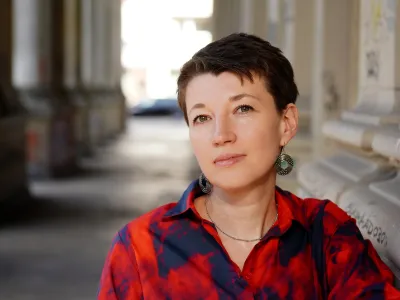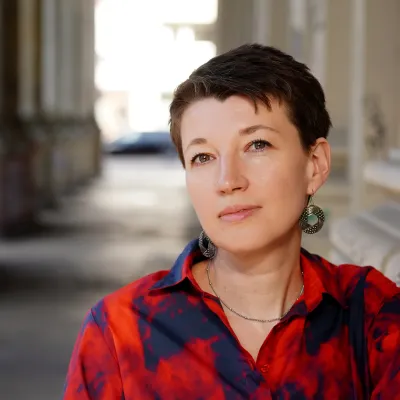
Julia Cimafiejeva
What will it take for Belarusian narratives to become part of Europe’s cultural landscape?
More about Julia Cimafiejeva
Julia Cimafiejeva is a poet, writer, and translator. In her writing, she brings together poetic and documentary forms, personal memory, and collective history. She reflects on what it means to have a voice and examines how political violence, authoritarian rule, and forced migration continue to resonate in language, bodies, and family histories.
She was born in 1982 in Śpiaryžža, in the Brahin district of southern Belarus. She was four years old when the Chernobyl disaster contaminated the region and her family had to leave. In the village she spoke trasianka, the countryside mix of Belarusian and Russian. In the city she switched to Russian, and then to Belarusian, a language that “tastes sweet” to her.
She studied English at the Minsk State Linguistic University and came to her own poetry through translation. Rendering Walt Whitman, Stephen Crane, and Sylvia Plath into Belarusian, she had to invent a poetic language for them, and then made it hers, she says. In 2009 she co-founded PrajdziSvet, an online magazine of translated literature that widened the public discourse of what could be said in Belarusian, she says. Since 2014 she has published six Belarusian poetry collections. Her translations won the Debut Literary Prize and the Carlos Sherman Prize.
In 2021 she first protested against the authoritarian regime of Alexander Lukashenko, who has ruled Belarus since 1994. In August 2020, days before the presidential election, she wrote “My European Poem” in English, a cry to readers abroad at a time when Belarus was absent from the headlines. Her English-language diary of the uprising became Minsk Diary and has appeared in six languages. In November 2020 she left Belarus with her husband, the writer Alhierd Bacharevič. Exile took them from Graz to Chemnitz, Zug, and Hamburg, and in 2025 to Berlin.
Motherfield, her first book in English, was shortlisted for the Derek Walcott Prize. Blutkreislauf, a cycle that traces her family through a century of forced labor, Chernobyl, and displacement, made the shortlist of the Internationaler Literaturpreis 2026 and earned her the Hilde Domin Prize for Literature in Exile. She also makes paper collages, cutting up and reassembling found material by hand.
As a Richard von Weizsäcker Fellow, she asked why Belarusian stories remain absent from Europe’s cultural map, and what it would take to change that.
Lebenslauf
1982 Born January 12 in Śpiaryžža, Brahin district, Homel region, Belarus
1986 Chernobyl: the family is resettled from the contaminated southern region
1999-2004 Studies in English language and literature, Minsk State Linguistic University
2001 Participates in protests against Alexander Lukashenko for the first time
2006–2009 Belarusian College, Minsk (independent institution outside the state system)
2009–2020 Co-founder and editor, PrajdziSvet, online magazine of translated literature (first issue May 27, 2009)
2013 Residency, Baltic Centre for Writers and Translators, Visby
2014 Publication: Kniha pamyłak (The Book of Mistakes), Minsk: Halijafy
2014–2015 MA in literary studies, Belarusian State University
2015 Shortlisted, Debut Literary Prize, for The Book of Mistakes
2016 Publication: Cyrk (Circus), Minsk: Zmicier Kolas
2017 Shortlisted, Natalia Arsiennieva Poetry Prize, for Circus; residency, Baltic Centre for Writers and Translators, Visby
2018 Polish edition: Cyrk i inne wiersze, translated by Bohdan Zadura, Lublin: Warsztaty Kultury; translation of Walt Whitman, Selected Poems, Minsk: Zmicier Kolas
2018 Debut Literary Prize, with two co-translators, for the Belarusian edition of Charles Bukowski’s Air and Light and Time and Space
2019 German edition: Zirkus, translated by Thomas Weiler and Tina Wünschmann, Berlin: edition.fotoTAPETA; translation of Enheduanna from the Sumerian, with Liavon Barščeŭski
2020 Publication: ROT; translation of Stephen Crane; Swedish edition of the diary: Dagar i Belarus, Stockholm: Norstedts
2020 Participates in the post-election protests; “My European Poem,” written August 5, published in English
2020 November: leaves Belarus for Graz, Writer in Exile stipend, City of Graz and Kulturvermittlung Steiermark
2021 Carlos Sherman Translation Prize, for the Stephen Crane translations
2021 German edition: Minsk. Tagebuch, translated from the English by Andreas Rostek, Berlin: edition.fotoTAPETA; participation in VERSschmuggel, Haus für Poesie, with Uljana Wolf
2022 Motherfield: Poems & Belarusian Protest Diary, translated by Valzhyna Mort and Hanif Abdurraqib, Dallas: Deep Vellum; longlisted, PEN Award for Poetry in Translation; shortlisted, Derek Walcott Prize
2022 German editions: Der Angststein and Minsk. Die Stadt, die ich vermisse; Belarusian edition: Voŭčyja jahady, Prague; Dutch edition of the diary
2022 Co-founder, PEN Berlin
2023 Writing workshop “While History Writes Itself,” Maxim Gorki Theater, Berlin; staged reading of her first play, EXTREMIST*INNEN, STUDIO Я, October 27 amd 28
2025 Publication: Krovazvarot, and the German edition Blutkreislauf, translated by Tina Wünschmann, Berlin: edition.fotoTAPETA; Ich zerschneide die Geschichte, collages, edition frölich
2025 Fellow, DAAD Artists-in-Berlin Program; participant in the International Literature Festival, Berlin
2026 Blutkreislauf: Lyrik-Empfehlungen 2026; shortlisted for International Literature Prize, Haus der Kulturen der Welt, Berlin
2026 Hilde Domin Prize for Literature in Exile, Heidelberg for Blutkreislauf
2026 Richard von Weizsäcker Fellow, Robert Bosch Academy, Berlin
Julia Cimafiejevas Richard-von-Weizsäcker-Fellowship
A Missing Piece of Europe: Belarusian Stories
Why are Belarusian stories still missing from the way Europe tells its own story? Julia Cimafiejeva, the first fellow from Belarus at the Robert Bosch Academy, made this absence the subject of her fellowship. She approached it from both sides: as a poet whose work is read and receives awards across Europe, and as an exile who is still regularly asked to explain where she comes from.
A shared European history
When Europe looks east, she argues, it sees Russia and Ukraine. Belarus is simply omitted. Yet Belarus has always been part of European history: from the 1920s, when Belarusian, Russian, Polish, and Yiddish were all state languages of Soviet Belarus, through Nazi occupation, the Holocaust, and forced labor in the Second World War, to Soviet deportations, the fallout from Chernobyl, and decades of dictatorship. “Who are Belarusians then, if not Europeans?” she asks. For her, equating Europe with the European Union is a mistake, politically and culturally. The Europe she knows from the east has always been multilingual and multicultural.
Literature and exile
Exile brings attention, she argues, but on terms she did not choose. In Germany she is often invited as a “writer in exile.” It is a label she rejects: “exile” describes her status, not her writing, she insists. “Language cannot be in exile,” she says. “Language just exists.” During her fellowship she worked on bringing Belarusian stories into the European conversation and making them an integral part of a shared European narrative rather than a footnote to Russia.
Through her meetings with decision-makers in politics, academia, culture, and civil society in Germany and across Europe, she therefore focused on making Belarusian culture and its narratives more visible. She regards Berlin as an ideal starting point for this because here, she says, she does not have to tell the story of Belarus, an unfree country, from the very beginning.