“When I was a kid, I was mad about guns. I had a bullet collection.” Jakkie Cilliers, now 70, is speaking from his home in Sweden when a rooster starts crowing so loudly midway through the interview that he excuses himself to go and feed it: a domestic interruption in a conversation about war, democracy, demographics, and Africa’s future.
These days, Cilliers spends his working life thinking about where Africa might be decades from now. In Pretoria, he heads the program African Futures and Innovation of the Institute for Security Studies (ISS), and during his Richard von Weizsäcker Fellowship, he turned that work into a book, Africa’s Road to Prosperity. It is a long way from his starting point as a young man: serving in uniform to uphold apartheid South Africa. What future did he see for himself then? He waves the question away. “I didn’t know what I was doing. I was a child.”
“My parents should have stopped me.”
Jakkie Cilliers grew up in Stellenbosch, the son of a sociology professor who went unpromoted for years because he opposed apartheid and the National Party. “Our family was quite ostracized in Stellenbosch,” Jakkie Cilliers says.
It was an unlikely family to produce a boy besotted with the army, and his lineage made it even stranger: Jakkie Cilliers’ great-great-grandfather, Sarel Cilliers, was the Voortrekkers’ spiritual leader, and his religious vow before the 1838 Battle of Blood River, in which the Boers defeated the Zulu army, became a key part of Afrikaner nationalist mythology. A later ancestor fought the British and was sent as a Boer prisoner to St. Helena, the remote South Atlantic island where Britain also exiled Napoleon.
Jakkie Cilliers’ parents believed in a just society for all South Africans but never pressed their views on their son. “My parents should have stopped me,” Jakkie Cilliers says. “But they didn’t.”
“It was a kind of rebellion”
Right after school, Jakkie Cilliers joined the military. Behind his love of guns, he also sees a painful motive. Although Boer by heritage, he had not learned Afrikaans at home. Moved from an English into an Afrikaans class, barely able to speak the language, he was caned by a teacher every day for a year. “It was probably the most traumatic thing I ever experienced in my life,” he says. Looking back, he sees his enlistment as rebellion “against them and against the system.”
He turned out to be good at soldiering: By the time he left 14 years later, he was a lieutenant colonel in the artillery, decorated for operations in Angola and left slightly deaf by the guns. He had also earned a bachelor’s degree, a master’s degree, and a PhD. “The military was very good for me,” he says to this day. “I have great respect and great appreciation of the military ethos, service, loyalty, discipline. It’s a remarkable brotherhood, more so than most people realize.”
“I just realized I can’t live with this.”
His undoing was, of all things, his academic research. His master’s thesis on the war in Rhodesia was quoted in Parliament by the opposition leader; his doctorate took him into the 1988 state of emergency and the Soweto uprising. “Both my master’s degree and my PhD politicized me much more than anything else,” he says.
Without meaning to, he had arrived at his parents’ question: What does a just society owe its people? Fellow officers, unnerved by a lieutenant colonel talking about equity, called him “black Jakkie.” When the State Security Council offered him a job, he balked. “I just realized I can’t live with this,” he says. By then, his political views had made him an outcast in the military.
He resigned in 1988. It brought him “full circle to where my parents had come from,” though “very, very differently.” Yet he did not turn on the military: Jakkie Cilliers still credits it with schooling a mind that “would have been completely chaotic” otherwise. Analysis, strategy, and planning were to stay his themes.
“What the ANC wanted and what I wanted was exactly the same thing.”
In March 1991, a year after Nelson Mandela was released from prison, Jakkie Cilliers flew to Lusaka to meet the ANC’s armed wing, the men he had been trained to fight. He expected hostility. Instead, “it was a fantastic meeting, absolutely eye‑opening,” he says. “What the ANC wanted and what I wanted was exactly the same thing.”
He found “sophisticated people,” with a vision of a peaceful, equitable South Africa that was again “part of the world” and “where everyone could vote.” By the time he left, he had become friends with Chris Hani, the ANC military commander who was assassinated two years later in an attempt to derail the negotiations to end apartheid.
Jakkie Cilliers came close to being killed himself. “There was quite an intimidation campaign,” he says. He suspects he survived only because each side assumed he belonged to the other. “That actually saved my bacon.”
The concept of a citizen in uniform
At 35, Jakkie Cilliers turned from opposing the old order to helping design what should replace it. He set out to build an institute for a democratic post‑apartheid defense force. Lusaka had shown him common ground; the military had taught him strategic thinking. For a model, he turned to Germany.
Borrowing the West German idea of the soldier as a “citizen in uniform,” he led delegations of former enemies to Bonn. His fledgling organization became the Institute for Security Studies (ISS), now a pan‑African institute working across security, governance, development, climate, and crime.
“Instability and violence is a symptom.”
Jakkie Cilliers led the ISS until 2015 and now chairs its board. But the longer he studied Africa’s conflicts, the more wary he became of looking backward: “You’re dealing with the symptoms of the problem the whole time,” he says. “Instability and violence is a symptom.” The cause, he concluded, was poverty; the cure was development.
As in Lusaka, his outlook changed. “What can you do to deal with these issues that change the future?” he began to ask. It was a return to military strategic thinking: look ahead, weigh options, discover room to maneuver. Strategic foresight, forecasting, and scenario‑planning became his field.
“It opens your mind to possibilities and opportunities.”
Which choices can put a country on a different path? One of the biggest forces Jakkie Cilliers sees shaping Africa’s future is demographics. It is the only continent where the labor force is still growing: “Why is Africa full of hope? Because it is young. It’s literally as simple as that,” he says. “Young people are people of ambition and hope. They see opportunity.”
“Africa will enter a potential demographic dividend around 2050,” he says and invokes the population pyramid: “Once it’s nice and fat around the middle, that’s when countries grow.”
But foresight is not prediction, he insists. “Nobody can predict.” It means understanding the forces already at work and the choices that can still change the outcome. “It opens up your mind to possibilities and to alternatives – broader than you generally would.”
“Africa is the next big market.”
That is also his message to Europe. While Europe still tends to see Africa in terms of poverty, instability, and aid, China, India, and the Gulf states increasingly see a market, he says. Africa still needs deeper trade integration and larger internal markets, Jakkie Cilliers argues, but its growing workforce gives it long-term economic weight. “Europe does not yet see Africa as an opportunity,” he says, “but it is the next big market.”
Ask Cilliers what strategy means and he reaches for his military past: “making sure that you have room for maneuver, that you have options, that you are not boxed in.” It describes his own trajectory, too: from soldier to bridge builder for a democratic South Africa, and from analyst to someone mapping future paths for his continent.
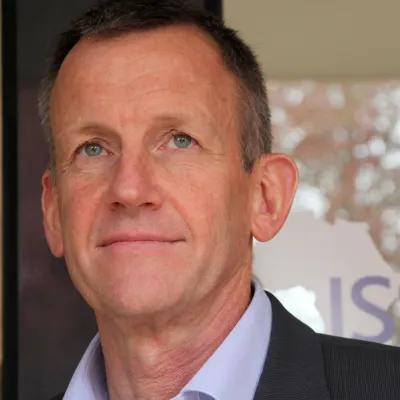
Jakkie Cilliers
Aug. – Dec. 2025
How can Africa turn its demographic growth into prosperity?