Kornely Kakachia comes to the Robert Bosch Academy as its first Georgian fellow to examine how Germany and the EU engage with its eastern edge. He knows the subject from the inside: As a political scientist he has spent his life fostering Georgia’s path to democracy through independent, nonpartisan analysis. Yet today, the Georgian Institute of Politics, the think tank he built, is shut. His country is drifting from the West against the wishes of most of its people.
“I started my life not from zero, but from minus two.”
Kornely Kakachia was born in 1971 in a provincial town in western Georgia. His father died when he was eight months old. His mother raised him. “Americans would call a person like me a self-made man,” he says.
He came of age as the Soviet Union fell apart. He was among the first generation of Georgian political scientists, who forced a discipline into a university that still taught scientific communism. The country around them was collapsing. “We had a civil war. We had blackouts. We stood in the queue for bread,” he says. “Some people call my generation a lost generation.”
The entire state – constitution, policies, political parties, civil society – had to be invented. Kornely Kakachia recalls his student days: “We visited our first Ministry of Foreign Affairs building. There were only three people. Georgia never had a foreign ministry. You needed to create everything from scratch.”
For him political science was the way forward, yet this meant a trade-off that still stings. To buy an apartment without joining a party or paying a bribe, he spent ten years working for the UN, forbidden by contract from publishing. “I lost my best years academically. But that was the way to do it without corruption,” he says.
“This should be for the public good.”
After the Rose Revolution – Georgia’s peaceful 2003 uprising that forced out President Eduard Shevardnadze, the former Soviet foreign minister who had led Georgia since 1992 – Kornely Kakachia returned to academia, went to Harvard's Kennedy School and to Columbia, and came home.
His students wanted him to start a university. He built a think tank instead. The Georgian Institute of Politics (GIP) opened in 2011, grew to twelve staff and became “a brand,” tied into European networks and projects.
Becoming a politician himself was never an option for him, even though he was repeatedly offered a seat. The GIP’s goal was to be independent and nonpartisan, Kornely Kakachia says. “The purpose was to bridge society, academia, and government in policy debates.”
“A lot of my friends called me Nokia,” he says, laughing. “You know Nokia, the cell phone? Their logo was 'connecting people.' I was able to connect different kinds of people, even sometimes opposite ones.” Then he turns serious. “Academia and think tanks have to contribute to societal knowledge, to involve people and be accountable to them,” he says. “At the end of the day, this should be for the public good.”
“This government doesn't want you to think.”
The GIP is now shut. It has suspended its operations, citing an increasingly repressive environment but also a sense that its mission has been undermined amid Georgia’s anti-democratic turn. Russian-style repressive laws made operating impossible as they effectively barred NGOs from receiving foreign funding.
“This government doesn't want you to think. And then they don't need an independent think tank," Kornely Kakachia says. “We were writing a lot of policy papers, policy briefs with recommendations, mostly for government. But if government doesn't listen to you, what's the point? For whom are you writing?"
The government’s closures are now also hitting the universities. A new rule permits one faculty per city, so a single institution may teach political science in all of Georgia. “Some critics call it sarcastically: ‘one city, one toilet.’ ”
“So, who are you then?”
The shrinking of Georgia’s political and civic spaces is like losing one’s identity, Kornely Kakachia says. And the pressure is becoming increasingly personal. As the government intensifies its campaign against liberal voices in Georgian universities, he now risks losing his academic position alongside many other colleagues. With his think tank closed and his professorship likely to follow, he asks: “So, who are you then?”
Then he answers with a joke: for three years he has held a Jean Monnet Chair, the most prestigious professorship the European Union awards. If the government pushes him out, he laughs, he will keep the brand: “I will have a Jean Monnet taxi. I will be the Jean Monnet taxi driver.”
He does not want to leave Georgia, he says. “The local people have to decide the fate of Georgian democracy.” Kornely Kakachia points to the Russian and Belarusian oppositions that left and lost touch with home. “We should not make the same mistake.”
“Georgia has a resistance culture.”
Those local people are where his hope now rests. What he studies as backsliding, he also watches as resistance. He coined “bandwagoning by stealth” for a government that accommodates Russia while its public resists and stays set on Europe and EU membership. “The government is doing one thing,” he says, “but it cannot do what it wants, because public opinion is pushing back.”
The pushing back is literal. Georgians have protested for more than 500 days, since the government shelved EU accession talks after an October 2024 election that international observers found marred by serious irregularities.
Ask him who inspires him, and Kornely Kakachia names the protesters rather than famous figures. “They are just ordinary citizens, and they are the ones who drive this democracy movement,” he says. “They sacrifice so much. They go to jail, they get fined, they get attacked, especially the women.”
“Georgia is an outpost of Western democracy.”
What angers him is the timing of Georgia’s backsliding. After Russia invaded Ukraine, Europe finally opened its door to Georgia: in December 2023, Georgia won EU candidate status, grouped with Ukraine and Moldova, holding what Kornely Kakachia calls “a winning ticket.” Then the government in Tbilisi let it slip and shelved accession talks until 2028.
Kornely Kakachia’s frustration is also that Europe does not see what it stands to lose. In the South Caucasus, he argues, the EU no longer competes with Russia alone but also with China, Iran and the Gulf states, powers that build the ports and roads and attach none of the democratic conditions Brussels does. The answer now is not to give up on Georgia but to make the case for it, he says: “Georgia can be an outpost of Western democracy in that region. If you have a successful Georgia, others will look and say, this poor Georgia managed, why can't we?”
“I believe in the spirit of Georgia's people.”
That is what he has come to Berlin to argue: that Europe should do more for Georgia, not less. The first Georgian ever named to the Robert Bosch Academy sees his Richard von Weizsäcker Fellowship as given less to him than to his country. It comes down to the bridge-building he is known for: in Berlin he means to tell Europe why Georgia matters and tell Georgians what Europe will and will not do. And for all the gloom, he remains an optimist. “I believe in the spirit of Georgia's people.”
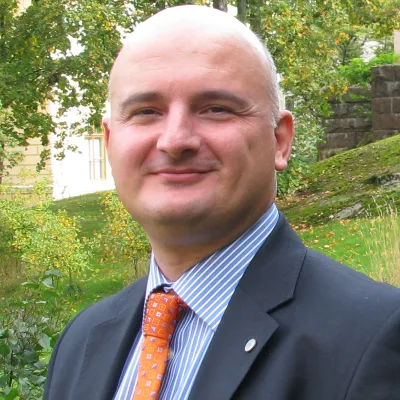
Kornely Kakachia
September 2026 - March 2027
Why does Europe still underestimate the strategic value of Georgia and the wider Black Sea region? And what would it take for Germany and the EU to engage seriously and stay the course, before competing and authoritarian powers fill the space they leave behind?