Asked about the books that shaped him, Vasyl Cherepanyn names the detective novels he read during his teenage and student years, and, within a sentence, turns to his work. “A protagonist is going through a dark corridor with only a flashlight. And what you see is only what this beam lights up.” What a detective does, he says, is “reading spaces, reading people, reading the surroundings. It’s basically a semiotic exercise.” This, he continues, “is what somehow defines me in all my endeavors and commitments up till now.”
Vasyl Cherepanyn has shone a spotlight on public spaces for nearly twenty years. He co-founded the Visual Culture Research Center (VCRC) in Kyiv in 2008 and saw it kicked out of his university. He has directed the Kyiv Biennial from 2015 right through Russia’s invasion. In 2025, he was appointed curator of the 14th Berlin Biennale.
“I kind of switched from melodies to the sound of words.”
He was born in 1980 in Ivano-Frankivsk, in Galicia in western Ukraine, a region “very much shaped by Greek Catholicism.” His father is a musician, his mother a nurse. “I’ve been playing music like since I was five,” Vasyl Cherepanyn says, “but then when I moved to Kyiv to study, I kind of switched from melodies to the sound of words.” He was six when Chornobyl happened and eleven when the Soviet Union collapsed. “When the established system collapses, then it can feel like a window of opportunities.”
“You have to prove the right for the image to exist.”
Vasyl Cherepanyn studied cultural studies at the National University of Kyiv-Mohyla Academy, a field “on the intersection of philosophy, anthropology, social critique, visual culture, history of art, and image studies.” For his doctorate he researched the Byzantine iconographic canon, the rules that fixed how a human image was allowed to be painted, and what twentieth-century art did with them.
Those rules were written in a war over pictures, he explains. Between 726 and 843 AD, Byzantine emperors burned icons and persecuted those who defended them. Their proponents developed their own image theory in order to resist the iconoclasm: “And this is a really groundbreaking challenge, if you think about it, because you have to prove the right for the image to exist when the whole context is against it.”
“They did not want to deal with dirty laundry in public.”
In 2008, Vasyl Cherepanyn co-founded the Visual Culture Research Center (VCRC) at his university. The center quickly gained artistic acclaim, yet in 2012 its exhibition Ukrainian Body – focusing on the body as a political field, including sexuality, gender roles, and queerness – was shut down by the university. No airing dirty laundry in public, please: “What is shown to the outside is polished, sort of progressive, liberal, whatever – and then there is what is in the cellar,” Vasyl Cherepanyn says about the university’s response. The academy ultimately kicked the entire center out “in a typical authoritarian manner,” and the VCRC reconstituted itself as an independent organization.
“That was very much about occupying the public space.”
Soon Kyiv itself became the center’s venue: During the 2013–2014 Maidan revolution, the VCRC ran a public program entitled “Global Protest” at the Open University on the occupied square. “That was very much about occupying the public space, what in ancient Greece was called ‘agora,’ in order to reclaim agency for the citizens and by the citizens.” Maidan, Vasyl Cherepanyn says, belongs with the Arab Spring and Tahrir Square, Syntagma Square in Athens, Occupy Wall Street, and Spain’s Indignados movement: a decade in which citizens took to the squares to claim a public.
His work has cost him. The 2012 closure of the exhibition was only a first stage, Vasyl Cherepanyn says. “Those who start with attacking the images, what follows next is attacking the people.” In September 2014, more than ten men recognized him from the work of the center and attacked him. “These people have names, they are neo-Nazis. They wanted to take revenge and almost killed me. I was lucky enough that I survived.”
“My face is partly reconstructed.” Vasyl Cherepanyn pauses, then he adopts a firmer voice: “No, I didn’t soften my position in that regard. Maybe quite the opposite. I started to be even more active, both locally and internationally.” In February 2017, fifteen masked men destroyed the center’s exhibition by the anarchist artist Davyd Chychkan, who was killed at the front, aged 39, last year.
“The realm of art is something that makes the impossible possible.”
“Art is not a lullaby,” Vasyl Cherepanyn says. For the philosopher-curator, who first learned about reading rooms in his teenage detective stories, art and space are inextricable. “Art is always defined by space,” he says, and it is “political in an ancient Greek sense: it can shape society, or a person, for its own wish, so that it can create a world that doesn’t exist. It can indeed make the impossible possible.” And space? “What is in the public space is not by chance called public. It’s a space which is open to everyone.”
In 2015 the VCRC launched the Kyiv Biennial. “It’s essentially been a war biennial from the beginning,” and did not stop when the full-scale Russian invasion came in 2022. “Instead of being subjugated to simply displacement, we rather took this weakness as an advantage. Instead of being just displaced, we have multiplaced the Kyiv Biennial.” It now runs in several cities at once, “like a perpetuum mobile.”
In 2027, the Berlin Biennale will also go beyond the art institutions. He wants “to push art beyond the white cube space, beyond the art bubble, to open it up for the wider audiences, that it becomes part of the city life, just of our everyday life,” Vasyl Cherepanyn says. “We foremost depart from the city space, and then art comes in. Not the other way around.”
“I think I’m working for my grandchildren.”
As the opening of the Biennale draws closer, Ukraine will enter its sixth year of war. “Normal life has been lost forever, for generations.” Asked what he hopes for, Vasyl Cherepanyn turns the question down. “I don’t operate with hopes. Hope is not my affect,” he says. He stopped listening to music when Russia’s full-scale invasion began in 2022, he later mentions.
Today’s military campaigns – in Ukraine, in Gaza, in Iran – have become wars of attrition, and together with the psychosocial effects of the COVID-19 pandemic, and the rise of artificial intelligence, they have created a permanent condition of global civil war, he argues. “I think I’m working for my grandchildren. My role is to contribute to the survival conditions, so there is a bigger chance that when the dark hour passes away, there will be something livable.”
“Art as such is what matters most in the long run.”
And then the curator comes back to art in public spaces: For the Kyiv Perennial in Berlin in 2024, Vasyl Cherepanyn and the Biennial team asked artists for work on what would become of Europe if the war went on for ten more years. One of the designs they picked, from the Dutch collective Experimental Jetset, went up as a poster across Berlin: a ten of spades, with spades shaped like spearheads. It is the card that fortune-tellers read as misfortune, grief, and tragic endings – yet rather than letting it stand, the artists decided to cross out the ten spades. “Art as such is what matters most in the long run,” Vasyl Cherepanyn says. “Such a cathartic gesture, a negation of the negation, appears today as one of the most urgent political acts we can still imagine.”
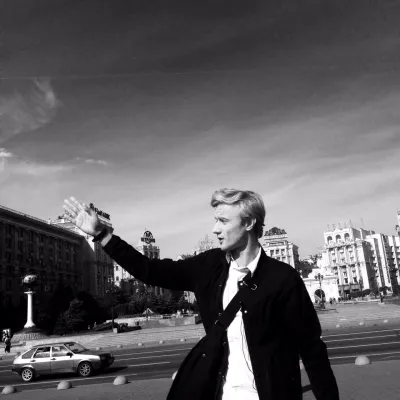
Vasyl Cherepanyn
Dec. 2025–May 2026
What can art and public space still do when war has become the permanent condition of the present?