You claim that we are witnessing a challenge to the enlightenment project in the West. What exactly is being questioned here?
john powell: When I think about enlightenment, what comes to mind is democracy, dignity, rule of law, science, and reasoning. Many modern societies have actually incorporated those themes. And the just concept of equality, that everybody matters, that everybody has dignity, is codified. It's codified in the intervention of human rights. It's codified in the Magna Charta. It's codified in our Constitution. And more than that, it's also expressed in terms of our norms in society.
But then you also have the so-called dark enlightenment movement. Its protagonists are the J.D. Vances, the Elon Musks and the Peter Thiels. Those folks don't believe in equality. They don't believe that all people should have dignity. They literally believe that some people are superior to other people and have the right to rule. They are not constrained, as Stephen Miller said, by the rule of law. They believe in power. This is a new paradigm guiding political and entrepreneurial actions.
Why are these people so successful in telling their story – and what would actually be the way to counter this?
jp: We live in a world of accelerating uncertainty. And we know that people can only process a limited amount of change in a short period of time without being stressed out. And today, the change all over the world is speeding up. This means that we're dealing with constant anxiety. Will there be another pandemic? What's going to happen with AI? Will my children have a place to live? What's going to happen with the environment?
Stories help us make meaning of the world, and there are two types. Breaking stories basically say the world is scary and dark. They're the reason that you're worried about your jobs. They're the reason that your kids are not doing well. It is this other that is the blame for our troubles and they threaten not just our nation state but also our future. They are made to be the source of all our problems.
The other type of stories is where you say, yes, the world is changing. But we need to listen and learn from each other. We need to listen not just with the head, but also with the heart. We need to have empathy. We need to collaborate. We need each other. That's called bridging. We need bridging stories to make meaning in a way that helps us.
You're working in the Bay Area, which was for a long time regarded as a place of positive visions for the future. Has this changed in your view?
jp: It's changed a lot. During President Trump's first term, many of the tech companies made it clear they would not cooperate with a government that was lurching to the far right while constructing smaller and smaller we’s. Then, in the second term for the Trump administration, at the inauguration, all the big tech leaders where there, basically kissing the ring.
Almost every company here in the US had rules on diversity, equity and inclusion. Almost all of them just wiped that out because Trump said he didn't like it. Google, for example, had an internal rule that they wouldn't work on military or defense contracts. They had a public statement saying they supported the healthy environment and belonging for all people. Now that's gone. Anthropic refused to license some of its AI technology to the government, unless the government made two assertions. One was not to engage in mass spying on citizens, and two not to have autonomous weapons on the battlefield. And the Defense Department not only refused, but it basically labeled Anthropic as a terrorist entity. Well, Open AI stepped up right away to fill the gap left by Anthropic.
What gives you reason to believe that the democratic societies can still kind of renew themselves?
jp: First of all, before a star burns out, it gets hotter. My hope is that a lot of this authoritarian stuff is really about to burn itself out. But we collectively have choice. We have agency. It's really important not to give that up. The majority of people don't support what ICE was doing in Minnesota and elsewhere. The majority doesn't support the bombing of Iran. But they're quiet, they're defeated. They feel like, what can I do? So, part of it is that we need to stay engaged, and we also need to have leaders who stand up. What we do matters. There must be belonging without othering.
The other thing is that there are a lot of breaking stories being told, but it's largely going on in the name of belonging. When people are afraid of immigrants, for example, they're afraid that the world is going to change and their group is no longer going to belong. So there is a profound need for humans to feel like they belong. And I think we can build on that and tell better stories. We have to reject a zero sum approach which insist that I can only do will if the other does poorly.
What makes Berlin and the European perspective relevant for your work right now?
jp: The phenomena of declining vibrancy and democracy is a global development. If we are going to work our way out of this, my belief is that Europe will have to play a big role.
It seems to me the EU and Germany in particular want to avoid a world that's ruled by big powers and not by rule of law and international norms. And I certainly support that. One could hope that there's some brakes on that in the United States, either in Congress or the courts or through elections. If not, it's a very dangerous and potentially dark world that we're moving toward. I see Europe trying to put the brakes on that, trying to actually reinvigorate and reimagine democratic institutions and norms, trying to figure it out through reason and respect. Europe has a deeper memory of what happens when large groups of people are othered and have at times used that lesson to point toward a different way. Not always perfect but instructive nonetheless.
And there are recent positive lessons we might build on. There was the people of Minnesota confronting ICE in sub-zero weather to protect their neighbors. There was the election in Hungary. There were a number of countries refusing to follow the United States into a war with Iran. There is hope while it is distributed, the heart of it is people engaged. It is in us.
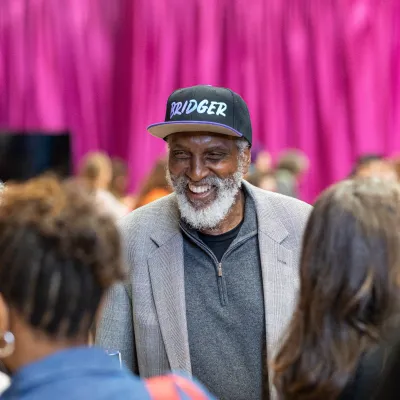
john powell
Residence: May 2026 – August 2026
Why are the protagonists of authoritarian ideologies so successful in promoting their worldview? And what kind of stories need to be told to counter this threat to democracy?